
Last Updated on August 5, 2026 by Cliche
What Happened During the Crash?

This was not a launch failure or a mid-flight explosion.
This was an “end-of-mission” problem that got pushed into deep space, then turned into a lunar impact.
What to publish first, and what to hold back
- Safe to publish right away: the predicted time window, the predicted region near Einstein Crater, the object’s rough size and mass, and why ground observers probably would not see much.
- Better to label as pending: crater diameter, exact coordinates, and any dramatic claims about dust “going hundreds of miles” until post-impact imagery arrives.
- Best follow-up hook: “confirmation will come from orbiter images after a scheduled pass.”
Date and time of the collision
Most coverage targeted August 5, 2026 at about 2:35 a.m. ET (about 06:35 UTC), with minor variation by model and update cycle.
AP-style copy can say “early Wednesday morning in the U.S.” and still include the exact time for readers who want it.
Could anyone see it live?
The impact flash was expected to be short and faint, while any dusty ejecta was more likely to show up in telescopes and, later, spacecraft images.
Even in a best-case sky, the impact site sat near the lunar limb, which is a rough place to catch a subtle plume from Earth.
One AP report described this as a long-shot event for backyard viewing, with orbiters having the real advantage.
Location of impact on the Moon
The target region was near Einstein Crater on the Moon’s western limb, close to the visual edge between the near side and the far side.
That geometry matters for storytellers, because it explains why your readers might see the Moon and still see “nothing.”
If you want an Earth-side analogy for the word “crater” without getting too technical, you can reference the lunar crater site in Nevada as a naming coincidence, not as evidence for lunar scale.
Speed and size of the rocket debris
Most estimates described a stage about 40 to 45 feet long, with a mass on the order of 4,000 kg.
Impact speed was widely reported around 5,400 mph (about 8,700 km/h, about 2.4 km/s), fast enough to excavate a fresh crater and toss debris upward, but still far slower than typical asteroid impacts.
Why Did the SpaceX Rocket Crash Into the Moon?
This is the part that trips up readers, because they assume “space junk” always falls back to Earth.
Once a stage gets pushed into a high-energy Earth-Moon path, it can hang around for a long time, and small gravitational nudges add up.
It started as a normal mission, then the stage became an orphan
Reporting linked the object to a Falcon 9 launch on January 15, 2025 that sent two private lunar landers on their way.
After that, the upper stage was left in an elongated trajectory that kept looping through cislunar space until impact day.
Tracking was public, and that shaped the story
Bill Gray, the astronomer behind the long-running Project Pluto tracking tools, published updates that helped focus attention on the timing and location.
If your audience is publishers, that detail is gold, because it shows why independent tracking can set the news agenda before official imagery lands.
Why “just deorbit it” is not always the choice operators make
Space experts pointed out that the crash was not the goal, and that an alternate disposal, like pushing the stage into solar orbit, can be possible in some cases.
For a clean explainer, keep it simple: a stage needs extra propellant and planning for a disposal burn, and deep-space mission design trades fuel against payload goals.
That trade is where policy pressure is building, since it turns a technical choice into a shared-risk choice.
A research note that’s worth quoting for authority
A 2026 arXiv preprint that physically characterized the object (2025-010D) described ground-based observations consistent with a long, cylindrical stage, and discussed rotation behavior that changed measurably during observations.
For bloggers, the “so what” is this: when a deep-space object is identifiable, science teams can plan observations more like a scheduled experiment than a surprise accident.
Scientific Opportunities From the Impact
If you cover space exploration, this is where the story gets better than the clickbait headline.
A known object, with a tracked path and a reasonable estimate of mass and speed, becomes a calibration point for impact cratering models.
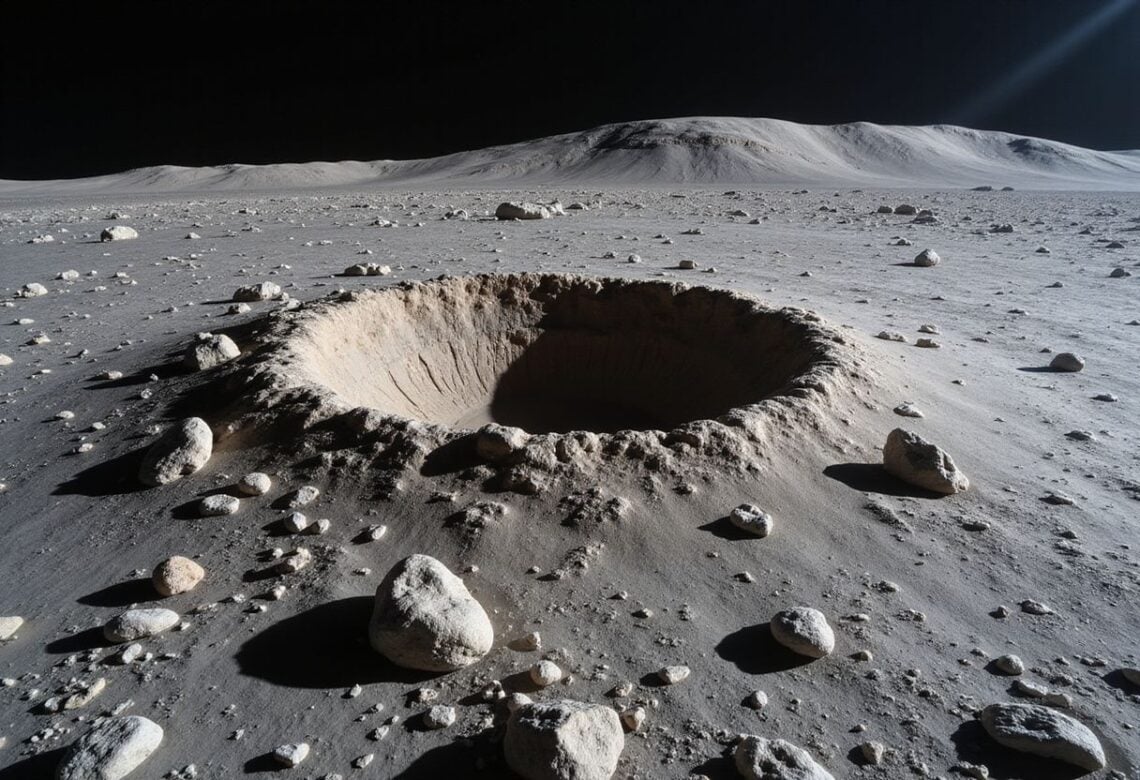
Creation of a new lunar crater
Pre-impact estimates ranged from about 25 meters to about 40 meters in diameter (about 80 to 130 feet), depending on the model used.
That size is small on lunar scales, but it is large enough for orbiters to measure cleanly once they get the right lighting and angle.
How this compares to earlier, intentional impacts
- Apollo era: NASA deliberately impacted hardware to create seismic signals and test instruments.
- LCROSS (2009): NASA directed a spent rocket stage into Cabeus crater near the lunar south pole to study the plume for signs of water.
- Now: a tracked, unplanned impact that still gives modelers a fresh “known input, measurable output” dataset.
Data collection by lunar orbiters (for example, LRO and Danuri)
NASA’s Lunar Reconnaissance Orbiter is the workhorse for confirming a new crater, because it can return crisp before-and-after images after a flyover.
AP reported that Danuri was expected to pass within a few kilometers of the object just minutes before impact, which is the kind of timing detail that readers love when you explain what it means for observation planning.
Publisher-friendly science angles that do well without hype
- How crater size estimates are made, and why different teams get different numbers.
- What a “plume” means on an airless body, and why it is more dust and debris than smoke.
- Why a near-limb site makes ground confirmation tough, even with great telescopes.
- What “impact cratering” studies teach mission planners about landing hazards and surface change.
Concerns About Space Debris
This impact did not threaten astronauts today. It still puts a spotlight on a bigger question: how the space debris conversation shifts once traffic grows beyond Earth orbit.
Risks of orbital pollution (Earth orbit vs. the Moon)
It helps to separate two things your readers mix together: objects in orbit and objects on the lunar surface.
The U.S. Space Force notes that debris in Earth orbit can travel around 22,000 miles per hour, which is why even small fragments can create real operational risk for satellites.
On the Moon, a dead stage becomes surface hardware, but it can still kick up fast-moving debris at impact and it adds clutter for future site planning.
Need for better deorbiting regulations
In the United States, several rule sets shape behavior, but they do not all map neatly onto lunar operations.
| Rule or framework | What it covers | What a publisher can do with it |
|---|---|---|
| FCC “five-year rule” (adopted in 2022, with compliance starting in 2024 for new launches) | Shorter post-mission disposal timelines for many licensed satellites in low Earth orbit | Use it to explain why “space junk rules” exist, then clarify that lunar disposal is a different bucket |
| NASA NPR 8715.6E (effective April 18, 2024) | NASA’s internal orbital debris mitigation requirements for its missions and partners | Quote it to show what “good housekeeping” looks like when an agency writes it down |
| UN COPUOS Space Debris Mitigation Guidelines (2007) | International consensus guidance for limiting debris growth | Frame it as norms, not enforcement, so readers understand why “who pays” is still messy |
| Artemis Accords | Principles for civil lunar activity, including planning for orbital debris mitigation and disposal | Explain why lunar traffic management is becoming part of public policy, not just engineering |
The cleanest way to cover responsibility without getting dragged into politics
If your draft starts drifting into elon musk fandom wars, trump hot takes, iran speculation, climate arguments, or even the Strait of Hormuz, pause and pull it back to documents, timings, and measurable outcomes.
Readers like debate, but publishers keep trust by labeling what is verified, what is estimated, and what is still pending imagery.
If you want one safe “action sentence,” it is this: ask operators to publish an end-of-life plan in plain language, before launch, with a disposal target that can be independently tracked.
Conclusion
This lunar impact is a headline, but your best post is the one that helps readers feel oriented, not stirred up. And yes, it is still a space debris story, even though the collision happened on the lunar surface.
Start with the timeline, because it is the anchor that keeps your draft from turning into a social-media collage. August 5, 2026 at about 2:35 a.m. ET (about 06:35 UTC) is the moment most outlets pinned down, and it is the line readers will quote back to you.
Then name the object plainly: a Falcon 9 upper stage left from a January 15, 2025 mission that sent private lunar landers toward the Moon.
That one sentence explains why this was avoidable in theory, while still acknowledging that mission design comes with tradeoffs.
Next, be honest about what people could see. Ground observers had a steep challenge, since the target region sat near the lunar limb and any flash was expected to be brief and faint.
That is why NASA’s Lunar Reconnaissance Orbiter matters more than a shaky phone video. AP reported that orbiter confirmation was expected after a flyover in the week after the impact. So if you publish fast, add a short “update box” in your CMS plan now, then refresh your post once imagery lands.
Here’s the part most bloggers skip: translate the science value into a reader payoff. “Impact cratering” can sound abstract, until you tell people it is the same math mission teams use to judge how a landing zone changes over time.
A tracked impact with a known-ish size and speed becomes a check on those models. That is a real space exploration takeaway, not trivia. If you want credible names to quote, keep it tight.
Bill Gray (often misspelled Bill Grey online) is central to the tracking narrative via Project Pluto updates, and Jonathan McDowell was widely quoted about why confirmation still waits on imaging.
Benjamin Fernando’s team work showed up in crater-size estimates and in the Danuri observation plan described by major outlets.
Now, about the comment-section chaos you already see coming. When people drag in china vs. the u.s., Supreme Court blame fantasies, or random trending topics like Ariana Grande and Chipotle, you do not have to follow them.
Just keep your post structured: what happened, what we know, what we do not know yet, and what changes once images arrive.
To make your article feel complete, finish with a checklist readers can trust.
- State the impact time in ET and UTC.
- Describe what the object was, and what mission left it behind.
- Use a crater size range, and label it as estimated until orbiter images confirm it.
- Explain why visibility from Earth was unlikely, so readers do not feel tricked.
- Point to the policy gap plainly: Earth-orbit rules exist, lunar disposal norms are still forming.
- Plan one update after LRO imagery, and one more after any peer-reviewed analysis replaces early estimates from arXiv.
Cover it that way, and you get the best of both worlds: the breaking-news hook, plus a post that stays useful after the first wave of links dies down.
Read more trending topics articles at ClichéMag.com
Images provided by Deposit Photos, BingAI, Adobe Stock, Unsplash, Pexels, Pixabay Freepik, & Creative Commons. Other images might be provided with permission by their respective copyright holders including AI generators.