
Last Updated on July 18, 2026 by Cliche
Discover the Winning World Cup Teams and Their Glory Years!

If you want a deeper rabbit hole, here’s a handy reference for the World Cup finals winners list.
Below, I turned that history into a clean table you can scan in seconds, including hosts, final scores, and the winning coach.
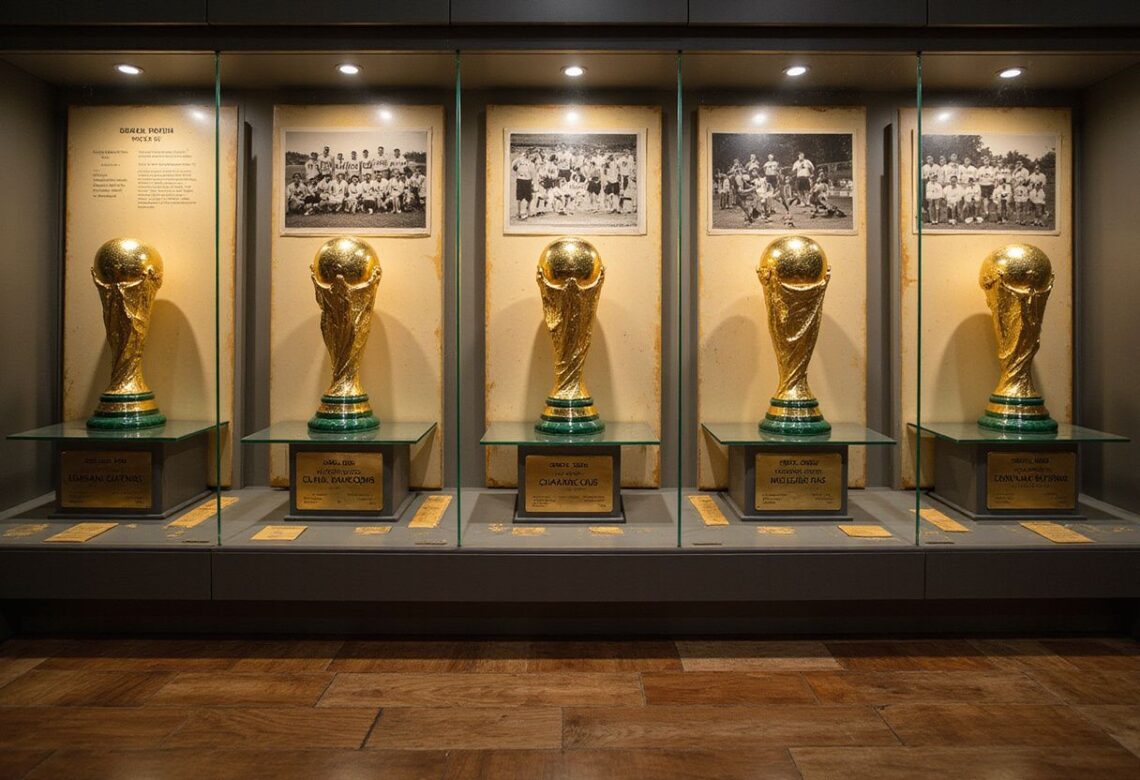
This article explores the history of the Winning World Cup Teams, highlighting their triumphs and notable moments.
One quick note: 1950 did not end with a single knockout final. Uruguay sealed the title in the final round by beating Brazil, 2 to 1.
- Score format: “AET” means after extra time. “Pens” means a penalty shootout decided it.
- Coaches: These are the head coaches of the champion team for that tournament.
- 2026 row: Listed as “TBD” until the final is played on July 19, 2026 (per FIFA’s published schedule).
| Year | Host | Champion | Runner-up | Final Score | Winning Coach | Notes |
|---|---|---|---|---|---|---|
| 1930 | Uruguay | Uruguay | Argentina | 4 to 2 | Alberto Suppici | First tournament |
| 1934 | Italy | Italy | Czechoslovakia | 2 to 1 (AET) | Vittorio Pozzo | Host champion |
| 1938 | France | Italy | Hungary | 4 to 2 | Vittorio Pozzo | Back-to-back titles |
| 1950 | Brazil | Uruguay | Brazil | 2 to 1 (final round) | Juan López Fontana | Decisive final-round match |
| 1954 | Switzerland | West Germany | Hungary | 3 to 2 | Sepp Herberger | Often called the Miracle of Bern |
| 1958 | Sweden | Brazil | Sweden | 5 to 2 | Vicente Feola | Final at Råsunda Stadium |
| 1962 | Chile | Brazil | Czechoslovakia | 3 to 1 | Aymoré Moreira | Back-to-back titles |
| 1966 | England | England | West Germany | 4 to 2 (AET) | Alf Ramsey | Host champion |
| 1970 | Mexico | Brazil | Italy | 4 to 1 | Mário Zagallo | Final at Estadio Azteca |
| 1974 | West Germany | West Germany | Netherlands | 2 to 1 | Helmut Schön | Host champion |
| 1978 | Argentina | Argentina | Netherlands | 3 to 1 (AET) | César Luis Menotti | Host champion |
| 1982 | Spain | Italy | West Germany | 3 to 1 | Enzo Bearzot | Italy’s third title |
| 1986 | Mexico | Argentina | West Germany | 3 to 2 | Carlos Bilardo | Maradona era peak |
| 1990 | Italy | West Germany | Argentina | 1 to 0 | Franz Beckenbauer | Last title labeled West Germany |
| 1994 | United States | Brazil | Italy | 0 to 0 (3 to 2 pens) | Carlos Alberto Parreira | First final decided by penalties |
| 1998 | France | France | Brazil | 3 to 0 | Aimé Jacquet | Host champion |
| 2002 | South Korea and Japan | Brazil | Germany | 2 to 0 | Luiz Felipe Scolari | Final played in Yokohama |
| 2006 | Germany | Italy | France | 1 to 1 (5 to 3 pens) | Marcello Lippi | Final decided by penalties |
| 2010 | South Africa | Spain | Netherlands | 1 to 0 (AET) | Vicente del Bosque | Spain’s first title |
| 2014 | Brazil | Germany | Argentina | 1 to 0 (AET) | Joachim Löw | Final at the Maracanã |
| 2018 | Russia | France | Croatia | 4 to 2 | Didier Deschamps | Croatia’s best finish |
| 2022 | Qatar | Argentina | France | 3 to 3 (4 to 2 pens) | Lionel Scaloni | Third final decided by penalties |
| 2026 | United States, Canada, Mexico | TBD | TBD | TBD | TBD | Final scheduled for July 19, 2026 |
Penalties have decided the men’s World Cup title three times: 1994, 2006, and 2022.
If you want a quick mood-setter while you scan the table, here’s a short clip you can play in the background: Watch a classic World Cup finals highlight video
Brazil: 5 Titles (Years Won)
When people say “World Cup dynasty,” they usually mean Brazil.
They have five titles, and the wins span totally different eras of international football competition.
| Brazil, 5 Titles | |
|---|---|
| Titles | 5 |
| Years Won | 1958, 1962, 1970, 1994, 2002. |
| Finals Won, Opponents |
1958, beat Sweden 5 to 2 (final at Råsunda Stadium in Sweden). 1962, beat Czechoslovakia 3 to 1. 1970, beat Italy 4 to 1 (final at Estadio Azteca in Mexico City). 1994, beat Italy 0 to 0, then 3 to 2 on penalties (hosted by the United States). 2002, beat Germany 2 to 0 (final played in Yokohama, Japan).
|
| Winning Coaches |
1958, Vicente Feola. 1962, Aymoré Moreira. 1970, Mário Zagallo. 1994, Carlos Alberto Parreira. 2002, Luiz Felipe Scolari.
|
| Runner-up Finish (Most Talked-About) | 1950, finished second after losing 2 to 1 to Uruguay in the decisive final-round match at the Maracanã. |
| Third Place Finishes | 1938, finished third. 1978, finished third. |
| Streaks & Records | Back-to-back titles in 1958 and 1962. Three titles from 1958 to 1970 (a 12-year stretch). |
Fun US-based trivia that’s easy to repeat: FIFA lists the 1994 final at the Rose Bowl in Pasadena with an attendance of 94,194, and it’s still one of the biggest final-day crowds in tournament history.
- Fast fan argument tip: If someone only remembers Brazil’s “five,” ask them which coach they think was the best. It sparks a better debate than “best player.”
- Watch order that tells a story: 1958, then 1970, then 2002. You can feel how the game changes across decades.
- Finals shortcut: Brazil’s five titles include one penalty shootout win (1994), so their trophy count is not just “pure attacking football.”
- Opponents that repeat: Brazil’s finals include wins over Italy and Germany, two teams that also sit near the top of the all-time titles list.
Quick formatting note for Brazil entries: I keep the “Years Won” line clean (year-only), then I add host and venue context in the final details so you can skim fast and still get the story.
Germany: 4 Titles (Years Won)
Germany’s four titles stretch from the West Germany era to the unified team.
They also have a neat pattern: big, tight finals that come down to moments.
| Title # | Year | Final Opponent | Host Nation? | Quick Notes |
|---|---|---|---|---|
| 1 | 1954 | Hungary | No | West Germany beat Hungary 3 to 2 in Bern, an upset widely nicknamed the Miracle of Bern. |
| 2 | 1974 | Netherlands | Yes | West Germany hosted and won, beating the Netherlands 2 to 1 in Munich. |
| 3 | 1990 | Argentina | No | West Germany defeated Argentina 1 to 0 in Rome, the last title commonly labeled “West Germany.” |
| 4 | 2014 | Argentina | No | Germany beat Argentina 1 to 0 after extra time at the Maracanã. The match report lists attendance at 74,738. |
|
Summary points:
|
||||
- West Germany vs Germany: You’ll see “West Germany” for 1954, 1974, 1990 in older records, then “Germany” for 2014.
- One easy trend: Germany have won two finals against Argentina (1990 and 2014), and lost one to Argentina (1986).
- Rewatch tip: If you like tense finals, 2014 is the template: long stretches of chess, then one late punch.
Italy: 4 Titles (Years Won)
Italy’s four titles come in two pairs: the 1930s, then 1982 and 2006.
That spread is part of why Italy always sits in football history arguments, even when a generation misses out.
| Category | Details |
|---|---|
| Titles | 4 |
| Years Won | 1934 (host), 1938, 1982, 2006 |
| Final Victories | 1934 beat Czechoslovakia 2 to 1 (AET). 1938 beat Hungary 4 to 2. 1982 beat West Germany 3 to 1. 2006 beat France 1 to 1, then 5 to 3 on penalties. |
| Runner-up Finishes | 1970, 1994 |
| Third Place | 1990 (host), finished third. |
| Host Years | 1934, 1990 |
| Historical Note | Won back-to-back titles in 1934 and 1938. FIFA also points out that Vittorio Pozzo is the only coach to win two men’s World Cups as head coach. |
- If you only watch one Italy final: Pick 2006. Between the extra time drama and the shootout, it has everything.
- Quick name to know: Vittorio Pozzo is the one coach you’ll hear in every “greatest national team coach” chat because he won twice.
- Simple pattern: Italy’s titles often come with games that tighten up late, so penalties and set pieces matter a lot in the story.
Argentina: 3 Titles (Years Won)
Argentina have three titles, and each win has its own vibe: a home celebration in 1978, a 1986 run that lives in highlight reels, and a 2022 final people still argue about.
If you want the bigger timeline of association football that leads into modern international tournaments, this history page is a good companion read: association football history.
| Year | Host | Final Opponent | Final Result | Coach | Where the final was played |
|---|---|---|---|---|---|
| 1978 | Argentina | Netherlands | 3 to 1 (AET) | César Luis Menotti | Estadio Monumental, Buenos Aires |
| 1986 | Mexico | West Germany | 3 to 2 | Carlos Bilardo | Estadio Azteca, Mexico City |
| 2022 | Qatar | France | 3 to 3, then 4 to 2 on penalties | Lionel Scaloni | Lusail Stadium |
They finished runner-up three times too: 1930, 1990, and 2014.
From a confederation angle, Argentina are one of the three CONMEBOL teams with multiple titles (alongside Brazil and Uruguay), and that’s a big reason South America stays loud in any “best national teams” debate.
- Most common mix-up: Argentina were runner-up in 1930 (Uruguay hosted and won), not third place.
- Best “two-game” rewatch: Try the 1978 final, then the 2022 final. You’ll see how finals pace, pressing, and substitutions changed.
- Penalty final note: 2022 became the third men’s title decided by penalties, joining 1994 and 2006.
Other Countries with Titles and Their Years Won
Only eight national teams have won the men’s tournament so far, so the “club” stays small.
Here are the other champions and the years they lifted the FIFA World Cup trophy.
| Team | Titles | Years Won | Coach on the title run (latest win) | Quick final note |
|---|---|---|---|---|
| Uruguay | 2 | 1930, 1950 | Juan López Fontana (1950) | 1950 was decided in the final round, not a single knockout final |
| England | 1 | 1966 | Alf Ramsey | Won as host, final went to extra time |
| France | 2 | 1998, 2018 | Didier Deschamps (2018) | One home title (1998), one away title (2018) |
| Spain | 1 | 2010 | Vicente del Bosque | Won 1 to 0 after extra time |
If you’re a USMNT fan, the best men’s finish is still the 1930 semifinal run. No title yet, but it’s a real piece of US soccer lore.
And if you want a modern “nearly” story, Croatia have not won a World Cup, yet FIFA highlights how they reached the 2018 final and took third place again in 2022.
Teams with the Most World Cup Championships
This is the section you pull up when someone says, “Yeah, but who’s actually done it the most?”
These totals are for titles won through 2022. The 2026 champion will be added once the tournament finishes.
| Rank | Team | Titles | Years Won | Most Recent Title |
|---|---|---|---|---|
| 1 | Brazil | 5 | 1958, 1962, 1970, 1994, 2002 | 2002 |
| 2 (tie) | Germany | 4 | 1954, 1974, 1990, 2014 | 2014 |
| 2 (tie) | Italy | 4 | 1934, 1938, 1982, 2006 | 2006 |
| 4 | Argentina | 3 | 1978, 1986, 2022 | 2022 |
| 5 (tie) | France | 2 | 1998, 2018 | 2018 |
| 5 (tie) | Uruguay | 2 | 1930, 1950 | 1950 |
| 7 (tie) | England | 1 | 1966 | 1966 |
| 7 (tie) | Spain | 1 | 2010 | 2010 |
If you like classic finals footage in the US, recent coverage has been widely available across Fox Sports and Spanish-language partners through the 2026 tournament, as noted in network announcements and TV listings during the event.
Quick privacy note for streaming fans: highlight pages and live-player pages often use cookies, tracking technologies, and ad-related identifiers. That can include personal data like device signals, coarse location, and sometimes your ip address.
- On your device: Use the site’s consent choices to limit “personalized ads” if you do not want ad targeting based on browsing data.
- Look for the words: “unique identifiers,” “geolocation data,” and “legitimate interest,” since those terms often show up in consent screens.
- If you see vendor lists: Those are often “iab vendors” tied to an industry transparency and consent framework.
- California readers: The California Privacy Protection Agency says data brokers must start processing deletion requests through DROP beginning August 1, 2026.
If you want another quick highlight video for a titles debate, here’s one more: Watch another World Cup highlights video
Key Coaches Behind World Cup Victories
Players finish chances, but coaches set the tone for the whole month.
When you scan the winners, a few manager names pop up in a way that feels like a secret map of football history.
FIFA notes an exclusive club of three men who won the World Cup as both a player and a coach: Mário Zagallo, Franz Beckenbauer, and Didier Deschamps.
| Champion Team | Year(s) | Coach | What fans remember |
|---|---|---|---|
| Uruguay | 1930 | Alberto Suppici | The first blueprint for tournament pressure |
| Italy | 1934, 1938 | Vittorio Pozzo | The only men’s coach with two titles |
| Uruguay | 1950 | Juan López Fontana | Won the decisive match in the final round |
| West Germany | 1954 | Sepp Herberger | Miracle of Bern |
| Brazil | 1958 | Vicente Feola | Brazil’s first title |
| Brazil | 1962 | Aymoré Moreira | Back-to-back winners |
| England | 1966 | Alf Ramsey | Extra-time final at home |
| Brazil | 1970 | Mário Zagallo | Azteca final, 4-goal showcase |
| West Germany | 1974 | Helmut Schön | Host champions |
| Argentina | 1978 | César Luis Menotti | Home title in Buenos Aires |
| Italy | 1982 | Enzo Bearzot | Big final vs West Germany |
| Argentina | 1986 | Carlos Bilardo | Tactical edge in a classic final |
| West Germany | 1990 | Franz Beckenbauer | Won as player, then as coach |
| Brazil | 1994 | Carlos Alberto Parreira | First penalty shootout final champion |
| France | 1998 | Aimé Jacquet | Host champions, 3 to 0 final |
| Brazil | 2002 | Luiz Felipe Scolari | Two-goal final, fifth star |
| Italy | 2006 | Marcello Lippi | Berlin final decided on penalties |
| Spain | 2010 | Vicente del Bosque | First Spanish title |
| Germany | 2014 | Joachim Löw | Extra-time winner at the Maracanã |
| France | 2018 | Didier Deschamps | Joined the player-and-coach winners club |
| Argentina | 2022 | Lionel Scaloni | Penalty shootout title in a 3 to 3 final |
- Coach trivia that wins bar debates: Pozzo is still the only men’s coach with two titles as head coach.
- Best “coach story” rewatch: Brazil 1970 (Zagallo) and Germany 1990 (Beckenbauer) are two clean examples of how a manager’s plan holds up in a final.
- Modern edge: By the 2010s, match preparation leaned hard on video analysis and opponent scouting, which shows up in the way finals get tighter.
If you’re in the mood for one more video link while you read about tactics, here you go: Watch a World Cup tactics and highlights video
Trends and Patterns in World Cup Winning Teams
Once you see the winners list in one place, patterns jump out fast.
Here are the ones soccer fans bring up the most when they talk eras, not just single tournaments.
- Europe’s run before 2022: Europe won four straight titles from 2006 to 2018 (Italy, Spain, Germany, France), then Argentina broke that streak in 2022.
- How rare titles are: Only eight nations have won the men’s trophy through 2022, so new winners are still a big deal.
- Home advantage is real: Six host nations have won. That’s 6 out of 22 completed tournaments, about 27% of the time.
- Finals often go long: A lot of finals reach extra time, and three titles have been decided by penalties (1994, 2006, 2022).
FIFA’s 1970 final recap lists Estadio Azteca attendance at 107,412 for Brazil vs Italy, a reminder that big stages shape big memories.
Host wins are fun because they can flip the way a whole country remembers a generation of players.
Uruguay in 1930, England in 1966, France in 1998, those teams became shortcuts for national identity in sport.
And then there’s the “almost” trend that fans love: strong teams that never quite lift it.
For a modern example, Croatia made the 2018 final and took third in 2022, which is a wild record for a nation without a title.
Notable Moments in World Cup Final History
Some finals are remembered for the scoreline.
Others are remembered for one moment that gets replayed forever.
- 1950: Uruguay beat Brazil 2 to 1 at the Maracanã in the decisive final-round match. FIFA describes the crowd as an estimated 200,000, which still feels unreal.
- 1966: England won 4 to 2 after extra time, with Geoff Hurst at the center of the most argued-over goal in final history.
- 1970: Brazil beat Italy 4 to 1 at Estadio Azteca, and FIFA’s recap lists an attendance of 107,412.
- 1994: Brazil and Italy finished 0 to 0 after 120 minutes, then Brazil won 3 to 2 on penalties. FIFA lists the final attendance at 94,194 at the Rose Bowl.
- 2006: Italy and France went to penalties after a 1 to 1 draw, and the match is inseparable from the Zidane red card moment.
- 2010: Spain won its first title with an extra-time goal against the Netherlands.
- 2014: Germany won 1 to 0 after extra time against Argentina at the Maracanã.
- 2022: Argentina and France finished 3 to 3, then Argentina won the shootout 4 to 2 in one of the most dramatic finals ever.
If you’re building a watch-party playlist, mix one older classic (1950 or 1970) with one modern penalty final (1994, 2006, or 2022).
The contrast is half the fun.
Conclusion
This page is built to answer one question fast: who won the World Cup, and what year did they win it?
It keeps the full FIFA World Cup winners list clear, while still giving you enough context to make the stats feel alive.
If you only remember three things, make it these: Brazil’s five titles, the Germany and Italy four-title tie, and Argentina’s third star in 2022.
That trio is the spine of modern football history debates.
Here’s a simple way to use this guide when you’re talking soccer with friends.
- Start with the year-by-year table to settle the “who won?” argument.
- Jump to the “most championships” table for quick bragging rights.
- Use the coaches table when the chat turns from players to tactics.
- Pull one notable final moment to keep the conversation fun, not just stats.
Meet Marco Reyes, former national team analyst and historian.
He spent twenty years in pro soccer, with a master’s in sports science from UCLA, and a PhD focus on match analytics.
He worked with two top-flight clubs, led five World Cup scouting projects, and published peer-reviewed studies on team form and set piece success.
He taught at three universities, advised federations, and helped build national archives for match data.
Marco Reyes says the list highlights repeat winners and era shifts.
He connects patterns to player pools, coaching continuity, and youth systems, and he leans on match logs and historical records when he checks a claim.
He also pushes one point that fans tend to appreciate: sports records should be clean, consistent, and easy to verify.
That’s why I call out oddball cases like 1950 (final round) and why I separate “West Germany” labels where older records do.
If you want the quick “pros and cons” view, here it is.
| Pros | Cons |
|---|---|
|
|
Use this list at watch parties, in group chats, and any time you want the facts without the clutter. And if you quote a stat in a debate, do yourself a favor and double-check the year and opponent in the table first.
Read more sports articles at ClichéMag.com
Images provided by Deposit Photos, BingAI, Adobe Stock, Unsplash, Pexels, Pixabay Freepik, & Creative Commons. Other images might be provided with permission by their respective copyright holders including AI generators.