
The most recognizable brands in streetwear didn’t start with massive budgets — they started with a logo, a vision, and the right people to bring it to life.
Walk through any fashion-forward city block and you’ll notice something: the brands that turn heads aren’t always the ones with the biggest marketing spend. They’re the ones with the most considered details — a perfectly placed chest logo, a tonal embroidered patch on a heavyweight hoodie, a screen-printed graphic that feels like it came from somewhere real. That kind of intentionality doesn’t happen by accident, and it rarely happens with a bulk overseas order.
A growing wave of independent clothing founders are rediscovering something the OG streetwear labels always knew: your local custom print and embroidery shop is one of your most powerful brand-building partners. Whether you’re sourcing custom embroidery for a clothing brand just getting off the ground or rethinking production on a label that’s already moving units, the case for going local is stronger than it’s ever been.
The Details Are the Brand
In an era where anyone can spin up a Shopify store and slap a logo on a Gildan tee, differentiation lives in the craft. Embroidery, in particular, has made a serious cultural comeback — not just in heritage workwear or dad hats, but across full streetwear collections, luxury-adjacent drops, and everything in between.
Founders who invest in custom embroidery for clothing brands do so for a simple reason: it communicates permanence in a way other methods can’t. Working with local shops gives brand owners direct control over placement, thread color, and construction — the kind of hands-on collaboration that overseas bulk orders simply don’t allow. The texture, the slight raise off the fabric, the way it catches light — embroidery carries a weight that a flat print can’t replicate. For an emerging label trying to signal quality and intentionality to a discerning audience, it’s less of a production choice and more of a brand statement. The difference between a logo that looks applied and one that looks like it belongs.
But embroidery is just the beginning of what a full-service local shop can bring to an indie label.
Understanding Your Decoration Options (And When to Use Each)
Building a cohesive collection often means mixing techniques. Here’s how the major decoration methods play to different brand needs:
Embroidery
Best for logos, chest pieces, sleeve hits, and structured headwear. Embroidery thrives on minimalist, high-contrast designs — a clean wordmark, a bold icon, a tonal badge. It adds perceived value instantly and holds up wash after wash. If your brand is positioning anywhere near the premium or heritage space, embroidery should be in your toolkit.
Screen Printing
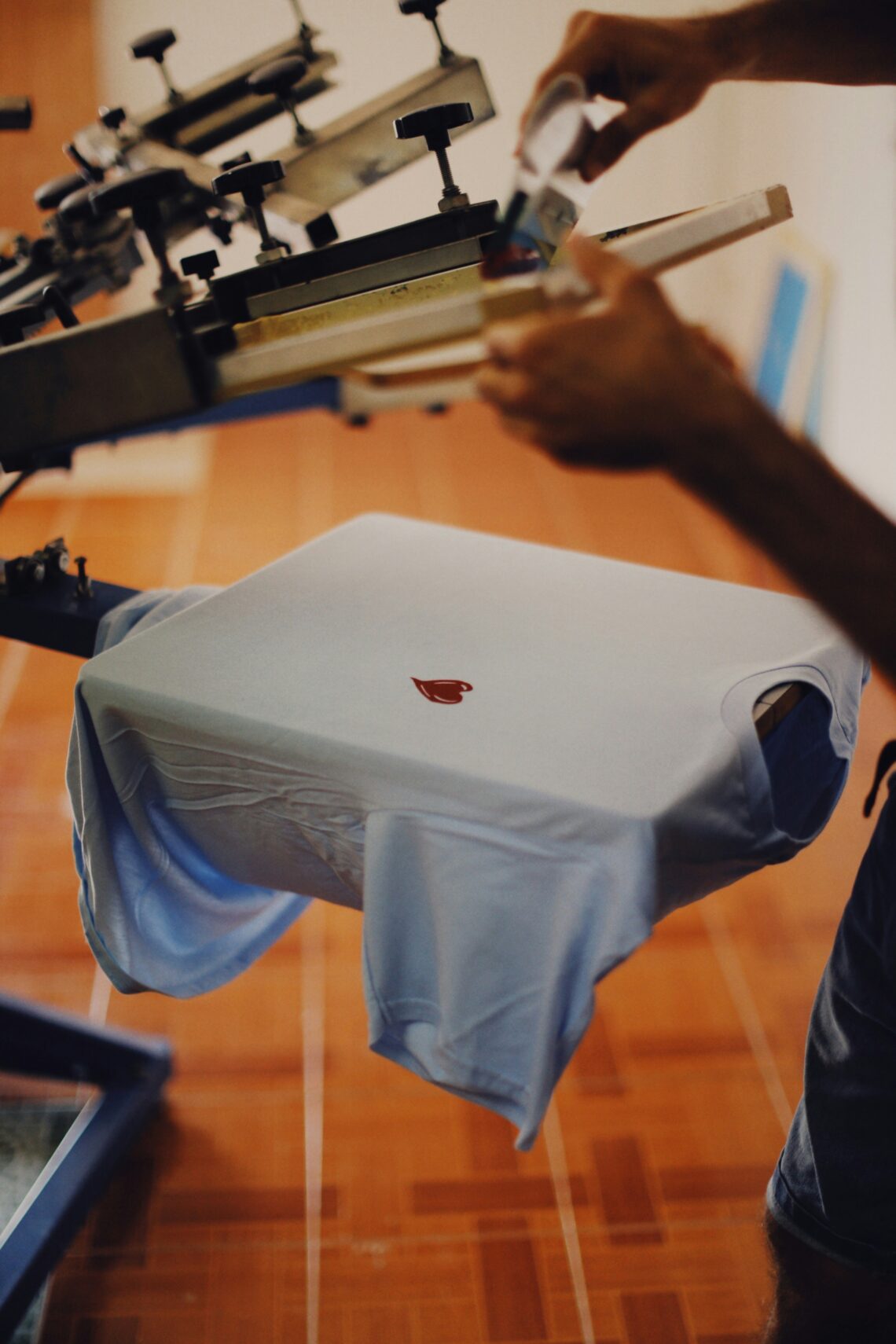
The workhorse of streetwear. When your design has bold graphics, oversized placement, or a limited color palette, screen printing delivers a crisp, vivid result at a cost that makes larger runs viable. Ink sits on the fabric in a way that feels tactile and intentional — especially on heavier blanks. It’s the reason graphic tees from the right shops still feel miles ahead of whatever’s trending on fast fashion.
DTG (Direct-to-Garment)
Direct-to-garment printing has closed the gap on quality significantly in recent years, and for small-batch drops or one-offs, it’s a game-changer. Complex, photorealistic graphics, gradients, and designs that would be cost-prohibitive to screen print are all on the table with DTG. It’s the go-to when you want variety without the minimum order pressure.
DTF (Direct-to-Film) & Custom Patches
DTF transfers offer incredible versatility — intricate designs can be applied to almost any fabric, in almost any placement, with no minimum. Custom patches take this a step further: woven or embroidered patches can be applied to jackets, bags, and accessories, turning a single design asset into a multi-product branding element. For brands building a world, not just a t-shirt, patches are an underutilized tool.
Why Local Beats Overseas for Indie Brands
The overseas bulk printing model works for brands that have already figured everything out — their sizes, their quantities, their market, their cash flow. For an emerging label still building its identity? It’s a trap.
Minimum order quantities lock you into inventory you may not move. Lead times of six to twelve weeks kill your ability to respond to what’s resonating. And when a sample comes back wrong — wrong colorway, wrong placement, wrong feel — you’re weeks and dollars deep with no fast path to a fix.
Local print shops offer what no overseas fulfillment center can: a real conversation. The ability to walk in with a sample garment, point at a reference, say I want the logo here, this size, in this thread color, and leave with a proof in days. That back-and-forth is where brands get refined. It’s where a founder with a vision and a shop that understands craft actually build something together.
Beyond speed and flexibility, there’s a sourcing story worth telling. Consumers — especially the fashion-literate audiences indie brands are courting — increasingly care about where and how things are made. A brand that can say we work with a local shop has a more compelling narrative than one that can’t name the country their product was printed in.
What to Look for in a Local Print Partner
Not all local shops are created equal. If you’re serious about the quality of your clothing brand’s physical product, here’s what to evaluate:
Full-service decoration capabilities. A shop that only does one thing will push every job toward that one thing, whether or not it’s the right call for your design. Look for a partner that offers embroidery, screen printing, DTG, and DTF under one roof — they’ll steer you toward the right method for each piece.
Willingness to work small. The best local print shops understand that today’s ten-piece sample run is tomorrow’s hundred-piece reorder. Find a shop that respects small batches and treats them with the same attention as larger jobs.
Transparent turnaround and communication. Ask about typical production timelines and how they handle revisions. A shop that’s upfront about process and proactive about communication will save you significant frustration.
Portfolio depth. Ask to see work across methods — not just their best screen print, but their cleanest embroidery, their most complex DTG job. You’re evaluating range and consistency, not just peak output.
Building Something That Lasts
The brands that endure aren’t the ones that scaled fastest — they’re the ones that built something with enough craft and identity that people actually wanted to wear it for years. That starts with a product that earns its price tag, which starts with the right production partners.
Independent clothing brand founders who invest early in understanding their decoration options and finding a local shop they trust aren’t just making better product — they’re building a more defensible brand. One that looks different in person than it does on a screen, that feels like it was made with intention, and that carries the kind of quiet confidence that doesn’t need a logo the size of a billboard to be noticed.
If you’re in the Pacific Northwest and looking to start that conversation, shops like The Print Plug — a multiple-year winner of Idaho’s Best Screen Printing & Embroidery and featured on Bloomberg’s World’s Greatest — are a good example of what credible, full-service local production looks like.
The tools are there. The question is whether your brand is ready to use them.
Read more fashion articles at ClichéMag.com
Images provided by Deposit Photos, BingAI, Adobe Stock, Unsplash, Pexels, Pixabay Freepik, & Creative Commons. Other images might be provided with permission by their respective copyright holders.