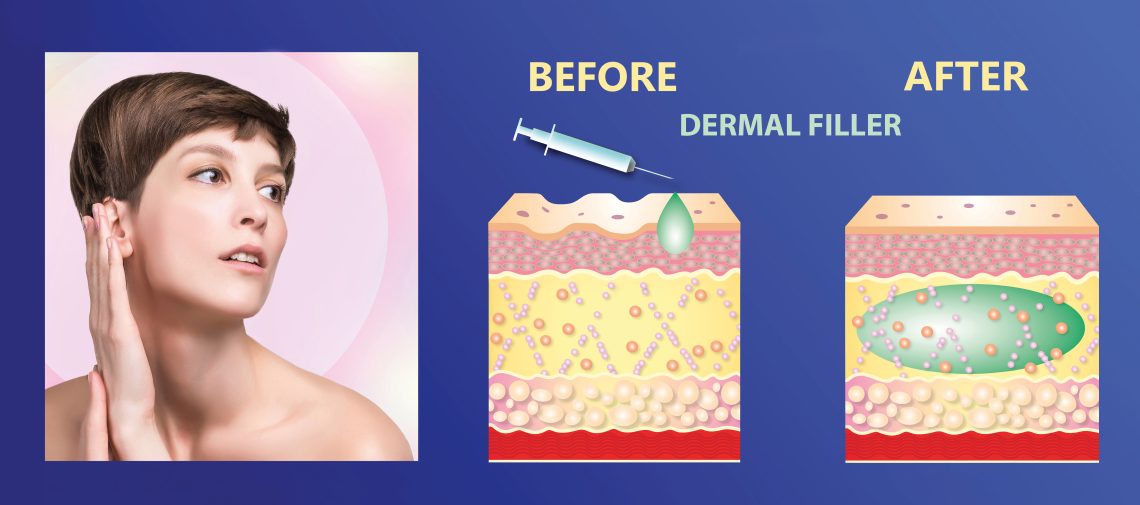

Smooth contours, youthful volume, and refined facial balance are no longer limited to surgical procedures. Fillers continue to gain popularity as a non-surgical aesthetic solution, offering efficient treatments with minimal recovery time. This growing popularity has reshaped the service delivery options, with mobile dermal fillers offering the convenience of professional treatment delivered directly to a client’s home.
Choosing the right filler requires more than preference alone. A clear understanding of the different types of dermal fillers and how they address specific concerns helps ensure results that look natural, feel balanced, and remain long-lasting.
What Are Dermal Fillers?
Dermal fillers are substances injected under the skin to restore volume, fill lines, or alter facial contours. Age-related changes such as collagen loss, fat redistribution, and reduced skin elasticity lead to hollowing and wrinkles.
Each filler is designed to compensate for these changes by adding volume or supporting tissue structure. Fillers differ in their biological composition, duration of effect, and the way they interact with the skin.
Types of Dermal Fillers
Dermal fillers are primarily categorized on the basis of their composition, which determines how they behave in the skin, how long the results last, and where they are applied.
Hyaluronic Acid (HA) Fillers
Hyaluronic acid fillers are mainly composed of biocompatible sugar molecules that are found naturally in human skin and connective tissue. These fillers offer temporary volume and hydration that typically lasts between 6 and 18 months. However, it relies on the formulation and treatment area.
Hyaluronic acid retains and attracts water, contributing to a volumizing effect. However, with time, the body slowly metabolizes it. These are its common applications:
- Fine lines and superficial wrinkles
- Lip volume
- Under-eye hollows
- Mild to moderate facial volume loss
If you are interested in skin rejuvenation, then brands like Juvederm and Restylane are already known to you. Typically, they are hyaluronic acid filler brands that offer multiple formulations designed to address different facial areas and tissue depths. These fillers are commonly used for skin rejuvenation and natural-looking facial enhancement, well-suited for professional dermal filler treatments performed in clinical or mobile settings.
Calcium Hydroxylapatite (CaHA) Fillers
Calcium hydroxylapatite fillers comprise a calcium-based microsphere suspension often identical to minerals that are naturally found in bones. They offer immediate volume and stimulate the production of collagen that brings results that last from 12 to 24 months.
Such fillers have a denser consistency than hyaluronic acid fillers and are used in areas that need more structural support. The common applications include:
- Deeper facial wrinkles and folds
- Cheek and mid-face volume restoration
- Hand rejuvenation
Due to the thickness and collagen-stimulating properties, calcium hydroxylapatite filler treatments are generally chosen for areas that demands for firmer support instead of any superficial correction.
Poly-L-Lactic Acid (PLLA) Fillers
Poly-L-lactic acid fillers are comprised of a biodegradable synthetic polymer that mainly acts as a collagen stimulator instead of an immediate volumizer. The impacts develop gradually, often lasting up to two years or more. However, this relies on the number of treatment sessions you are scheduling.
PLLA functions by triggering the natural collagen production of the body. This leads to a significant enhancement in skin thickness and volume. Their typical applications are for:
- Generalized facial volume loss
- Age-related skin thinning
- Long-term structural support
Dermal filler treatment with poly-L-lactic acid helps in addressing the loss of volume by supporting the natural collagen production of the skin instead of offering immediate filling. This type of approach helps with gradual, progressive enhancement to skin’s thickness or structure.
Polymethylmethacrylate (PMMA) Fillers
Polymethylmethacrylate fillers typically comprise collagen in combination with non-biodegradable synthetic microspheres, offering a lasting structural support. These fillers are mainly considered semi-permanent as microspheres remain in place even if the collagen carrier gets absorbed. Their typical applications are:
- Deep wrinkles
- Acne scars
- Areas requiring long-term correction
Polymethylmethacrylate fillers in dermal filler treatment can help to offer sustained structural correction in areas affected by scarring or deep wrinkles. Their lasting nature is effective in treating concerns that need extended support.
Autologous Fat Transfer (Fat Fillers)
Autologous fat fillers implement the patient’s own fat tissues that are obtained through liposuction and gets reinjuected into facial areas suffering from volume loss. The result duration stays variable since some transferred fat gets reabsorbed, while some may persist long-term.
Fat transfer offers volume with the use of biologically compatible materials and involves a more challenging procedure than the injectable fillers. It is mainly used for:
- Volume restoration
- Facial contouring
- Under-eye hollows
This method is ideal for a longer-term facial volume correction and contour enhancement. However, the outcomes might vary, and the process involves more complexities than any other injectable fillers.
Selecting The Best Filler For Your Needs
Choosing the right dermal filler treatment generally relies on multiple clinical and personal factors instead of a single”best” option.
- Treatment Area
Each fillers are formulated for its distinctive depths and types of tissues. Soft fillers are typically used across the delicate areas, while denser fillers are implemented where long-term support is required.
- Desired Duration
Some filler types are temporary and break down naturally, while others are longer-lasting. Temporary fillers helps adjustments over time, whereas long-lasting fillers are used when long-term correction is required.
- Degree of Volume Loss or Wrinkling
Mild concerns often need a different type of filler compared to the deeper folds or notable volume loss.
- Reversibility
Certain fillers get dissolved or naturally absorbed, although others stay in place for longer periods. This is a vital consideration, mainly for first-timers.
- Individual Factors
Age, quality of skin, facial anatomy, personal choices, and medical history are the major factors that determine the choice of filler treatment.
- Provider Expertise
The right filler choice depends on the injector’s experience and skill. Professional med spa providers like GoTox Girl offer mobile dermal filler treatments, delivering expert care to your home.
Conclusion
Dermal fillers offer the most versatile, non-invasive approach to facial rejuvenation when selection is done strategically. Knowing about the different types of fillers and their benefits will help you make the safest decisions and achieve natural outcomes. It is important to choose a personalized treatment plan that is guided by a skilled skin care expert. This ensures that the enhancements complement your facial features, besides maintaining skin health.
Read more beauty articles at ClichéMag.com
Images provided by Deposit Photos, BingAI, Adobe Stock, Unsplash, Pexels, Pixabay Freepik, & Creative Commons. Other images might be provided with permission by their respective copyright holders.