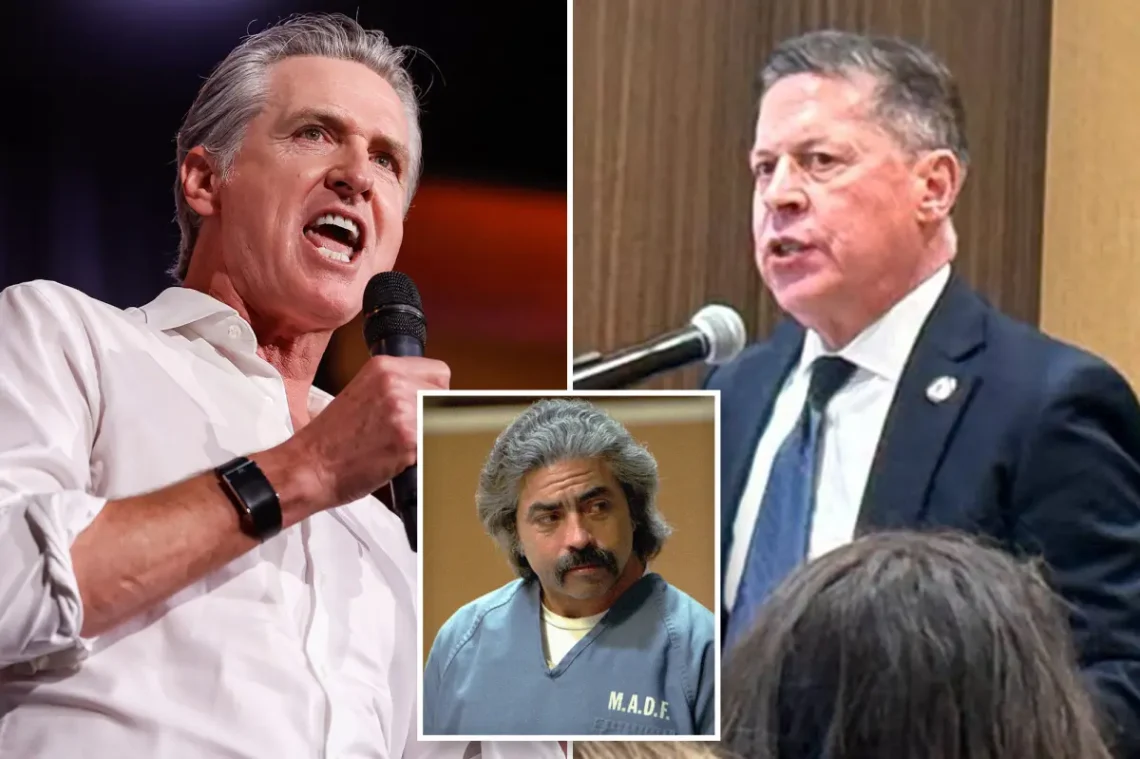


A California district attorney is vowing to keep pursuing the death penalty in murder cases despite Gov. Gavin Newsom’s decision to commute the sentences of every inmate on the state’s death row.
San Joaquin County District Attorney Ron Freitas blasted the Democratic governor’s sweeping clemency move, accusing his office of sidelining victims’ families and wiping away decades of work by prosecutors seeking justice for some of California’s most notorious killers.
“We will continue to prosecute the worst of the worst and selectively find those individuals, and we will continue to seek the death penalty in the right cases, for the right individuals, for our right victims,” Freitas told KCRA.
Freitas said victims’ families were left devastated by the decision, which he described as a sudden erasure of the justice they had spent years waiting for.
“Our victims are amazing, to have gone through what they’ve gone through. Waiting for their cases to be solved, seeing,” he said.
“And now the appellate system and to have so much taken away overnight in one stroke of a pen, I cannot tell you how devastated they are, but also how inspired we are all the district attorneys across the state to fight for them and to get them justice.”
Newsom announced Thursday that he would commute the death sentences of all 548 inmates on California’s death row, effectively replacing their capital punishment with life imprisonment without the possibility of parole.
The governor defended the move in a letter to Californians, arguing that the state should not execute prisoners because of concerns about the morality of state-sanctioned killing and the possibility of wrongful convictions.
“But as Governor, I have concluded the state cannot morally kill them,” Newsom wrote, adding that the inmates could instead “die in obscurity while we forever remember and honor their victims.”
The move is the boldest step yet in Newsom’s long-running opposition to capital punishment. It comes as the termed-out governor prepares to leave office and openly weighs a 2028 presidential run.
He imposed a moratorium on executions in 2019, though prosecutors have remained legally permitted to seek death sentences in eligible cases. California has not carried out an execution since 2006.
Nationally, about two-thirds of Americans (66%) support the death penalty for people convicted of murder and 32% oppose it, according to a Pew Research Center survey from July.
The sweeping move has not abolished capital punishment in California, and Freitas made clear that his office will continue seeking death sentences in eligible cases.
“It was unbelievable, absolutely devastating to have worked so hard on so many cases for our victims and to see this mass erasure of justice. It was very, very disappointing,” he said.
The prosecutor also accused Newsom’s administration of failing to properly consult district attorneys before making the announcement, saying victims’ families and prosecutors were deprived of an opportunity to weigh in.
He pushed back against the governor’s argument that all death-row inmates should be treated equally under the clemency decision, emphasizing that the cases involved some of the most violent criminals in the state’s prison system.
“These cases that are the worst of the worst,” he said. “These are mass murderers, repeat offenders, serial killers, children killers, rapists. Literally the worst of the worst that we have in the system.”
The governor has said he consulted crime victims and survivors, public safety experts, religious leaders and civil rights advocates before deciding to commute every sentence.
He argued that making distinctions between inmates based on their crimes would create two classes of murder victims.
Newsom said the death penalty was incompatible with California’s values and pointed to concerns about wrongful convictions and the state’s long-delayed capital punishment system.
The commutations will not release any inmates or make them eligible for parole. However, the California Supreme Court must approve the changes in hundreds of cases involving multiple felony convictions.
Freitas is not the only prosecutor pushing back.
Los Angeles County District Attorney Nathan Hochman said in a statement that the commutations do not end the death penalty in California.
“Only the Legislature or the voters can do that,” Hochman said. “Californians have been asked on two separate ballot initiatives to abolish the death penalty and both times they have chosen to keep it for the most serious crimes.”
Download The California Post App, follow us on social, and subscribe to our newsletters
California Post News: Facebook, Instagram, TikTok, X, YouTube, WhatsApp, LinkedIn
California Post Sports Facebook, Instagram, TikTok, YouTube, X
California Post Opinion
California Post Newsletters: Sign up here!
California Post App: Download here!
Home delivery: Sign up here!
Page Six Hollywood: Sign up here!