
Last Updated on May 13, 2026 by Cliche
The question regarding the cultural appropriation of dirndls is frequently asked. Every September, the same question circulates in fashion groups and Oktoberfest planning threads across the US. Buying a dirndl is often associated with the appreciation of German and Austrian culture, and the thread devolves into a debate that never quite reaches a useful conclusion.
Here is the honest answer: yes, non-Germans can wear a dirndl. But the question worth asking is not whether you can. It is how, and why, and what kind. That distinction matters more than most guides on this topic are willing to acknowledge.
Where Does the Dirndl Appropriation Question Come From?
The growing popularity of dirndls is accompanied by global attention. And the question regarding other cultures using and misusing the dirndls has arisen many times.
Coverage from International media
The cultural appropriation debate over dirndls flared publicly in 2018, when The Guardian reported that tourists wearing “sexy Alpine outfits” at Oktoberfest drew criticism from locals and commentators.
Condemnation by Munich Critics
A Munich-based crime author described some tourist versions of the dress as “porno dresses, short and low-cut and cheap material.” Franz Thalhammer, a former chairman of the Munich folk group Georgenstoana Baierbrunn, put it more bluntly. He said that Australian and Italian tourists had “forked out €250 for a complete Bavarian outfit and think they’re Bavarians,” comparing it to walking around half-naked and claiming to be Australian.
These were not fringe opinions. Shop owners at Munich Trachten stores reported customers specifically requesting “sexier” versions of the dress. The coverage turned what had been a quiet local frustration into an international conversation.
But the frustration was targeted. It was not about nationality. It was about what people were wearing and how they were wearing it.
The History Makes the Dirndl Appropriation Question More Complicated
The dirndl does carry a layer of history that most wearers at American Oktoberfest celebrations know nothing about, and it is worth understanding.
From Farm Fields to International Platform
The dress began as practical workwear for Alpine servants and rural women in the 16th and 17th centuries. In the late 19th century, Jewish brothers Julius and Moritz Wallach played a central role in launching dirndls into a commercial fashion. Their work was instrumental in bringing the dress to international attention.
The First Controversy of Dirndls: Appropriation by Nazis
In the 1930s and 1940s, the Nazi regime appropriated the dirndl as a symbol of idealized German rural femininity. It was used in propaganda imagery alongside blonde women as a visual for Aryan domesticity. Jewish women were prohibited from wearing it. In 1938, the Wallach brothers’ business was forcibly “Aryanised” and taken from them.
Gradual Restoration of Dirndls after the War
After the war, the dress declined sharply in popularity because of its association with that propaganda. A modest revival came at the 1972 Munich Olympics, when hostesses wore sky-blue dirndls as a promotion of Bavarian identity. The 1980s saw further recovery as environmental movements embraced traditional clothing. By the 1990s, it had fully re-established itself as a festival garment.
History Supports the Respectful Presentation of Dirndls
The history has always been in support of a respectful portrayal of dirndls. The elites borrowed it from the peasants, and the Wallach brothers revamped the dirndls to promote it to the global stage. Both of these events were unopposed and appreciated by the locals. The dirndl was appropriated first by the Nazis,and the correct response is not to abandon the dress but to reclaim it through education and inclusion.
What Bavarians Actually Think About Dirndl?
The honest summary of local opinion is this: most Bavarians welcome visitors who wear genuine, well-made traditional dress to Oktoberfest. They are not welcoming toward cheap polyester costumes with skirts four inches above the knee and a blouse designed to function as a push-up bra.
The Root of the Dirndl Controversy
The problem, as locals consistently describe it, is not foreigners wearing the dirndl, instead it is the disrespectful wearing that is unacceptable. A genuine dirndl worn correctly signals effort, respect, and an interest in the culture. On the other hand, a costume version with the word “Fräulein” printed on it signals the opposite.
Bavarian-born writer and former Brauwelt editor Conrad Seidl summed it up: “Before readers headed for the Oktoberfest lose any sleep over the issue, let me say that it is quite okay to wear Bavarian dirndls or authentic lederhosen. I can say this with certainty because having been born in Munich, I am allowed to self-identify as a member of that minority culture called Bavarian.”
The locals agree upon the fact that the issue is treating a traditional dress as a costume without understanding its cultural meaning and history.
The Actual Distinction that Matters
The question “can non-Germans wear a dirndl?” is the wrong frame. The question that produces a more useful answer is: what kind of dirndl, and how?
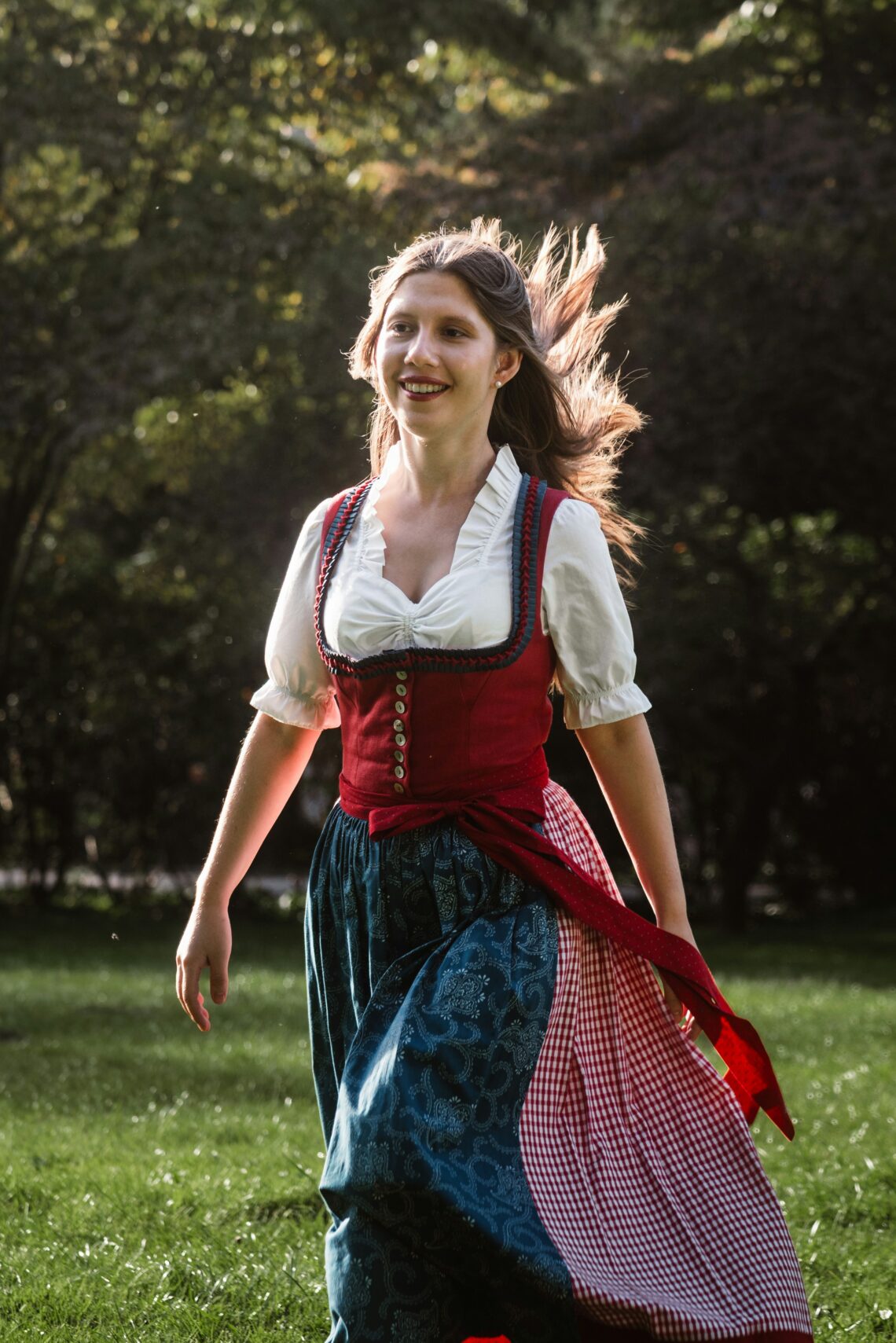
Genuine tracht brands like Dirndl Online Shop & Krueger Dirndl and Gottseidank make genuine dirndl from natural fabrics with a structured bodice, proper blouse, and embroidered apron. People wear them with an understanding that what they are wearing is not appropriation. It is participation. Bavarians who take their Tracht seriously appreciate visitors who take it seriously, too.
A cheap polyester two-piece with a neckline at the navel and a skirt that barely covers the thigh, worn with no particular understanding or interest in what the garment is, earns the criticism it receives. Not because the wearer is foreign, but because the garment itself is a distortion of the original.
The line is not drawn at nationality. It is drawn at intent and at quality.
Here is what that looks like in practice.
Wearing a Dirndl Respectfully Means:
- Choosing a genuine dress in natural fabric, cotton, linen, velvet, or silk, with a structured bodice and a skirt that hits at or below the knee
- Wearing the blouse underneath, not as a standalone top
- Tying the apron bow with intention, understanding that its placement carries meaning in traditional settings
- Treating it as a cultural dress worn at a cultural event, not as a Halloween costume worn at a theme party
Wearing a Dirndl Disrespectfully Means:
- Buying a polyester “costume” marketed with names like “Beer Garden Babe” or “Flirty Fraulein”
- Wearing a version deliberately designed to sexualise the dress with a skirt above mid-thigh and a bodice that functions as lingerie
- Treating the garment as a joke or a caricature of Bavarian culture
- Wearing it ironically, because locals wear them sincerely
What About American Oktoberfest?
American Oktoberfest celebrations operate under different norms than Munich’s Wiesn, and that is not a problem. They are their own events with their own cultures.
The Dirndls are More Expressive and Relaxed
Around 80 to 90 percent of American women attending Oktoberfest festivals wear some version of a dirndl. The dress code is more relaxed, the styling is often more expressive, and no one is grading outfits against a traditional Bavarian standard. A slightly shorter dirndl dress in a bold color, worn with ankle boots and a coloured blouse instead of white, is perfectly at home at an American festival.
The expectation at American events is festive participation, not ethnographic accuracy. The main thing to avoid is the costume-store version that misrepresents what the dress actually is.
Bottom Line
Non-Germans wearing a dirndl is not cultural appropriation. Bavaria and Austria have never treated the dirndl as an exclusive cultural property unavailable to outsiders. The dress has been sold internationally, adapted by high fashion, worn by celebrities of every background, and embraced at Oktoberfest events across six continents.
What Bavarians object to is not foreigners wearing the dress. It is the distorted, sexualised, cheaply made version that treats their regional identity as a theme party prop.
Buy a genuine dirndl. Understand what you are wearing. Wear it with respect for the culture it comes from. No Bavarian will have a problem with that. Several will probably compliment you.
The people who will have a problem are the same people who object to tourists showing up to any cultural event without putting in the effort to understand what the event actually is. That objection is fair regardless of what you are wearing.
Read more lifestyle articles at ClichéMag.com
Images provided by Deposit Photos, BingAI, Adobe Stock, Unsplash, Pexels, Pixabay Freepik, & Creative Commons. Other images might be provided with permission by their respective copyright holders.