


Last Updated on November 16, 2026 by Cliche
An AI-first phone is a smartphone built from the OS upward to run agentic AI that autonomously completes multi-step tasks across apps. AI-powered smartphones are best for Apple phone users and AI users who want faster help with writing, translation, photos, and planning, while people who dislike granting broad app permissions should wait for clearer controls.
The important distinction is that artificial intelligence no longer just edits a photo or answers a question. An AI agent can interpret a goal, choose approved tools, and carry out several related actions with your review at key points.
July 2026 marked another wave of attention around AI-first phones, including StepFun’s StepX Neo concept and its Step AOS software. The bigger story is not one handset, it is the move from isolated AI features to a phone that can coordinate work across apps.
For iPhone users, that change matters because Apple Intelligence already runs a mix of on-device and private cloud processing. For Android users, Galaxy AI, Google Gemini, and carrier-led concepts point to a wider race to make phones more proactive without giving up privacy or control.
This guide explains what separates an AI-first device from an ordinary smartphone, how agentic AI works, what operating systems make it possible, and which permission checks matter before you trust an AI agent with travel, messages, money, or personal data.
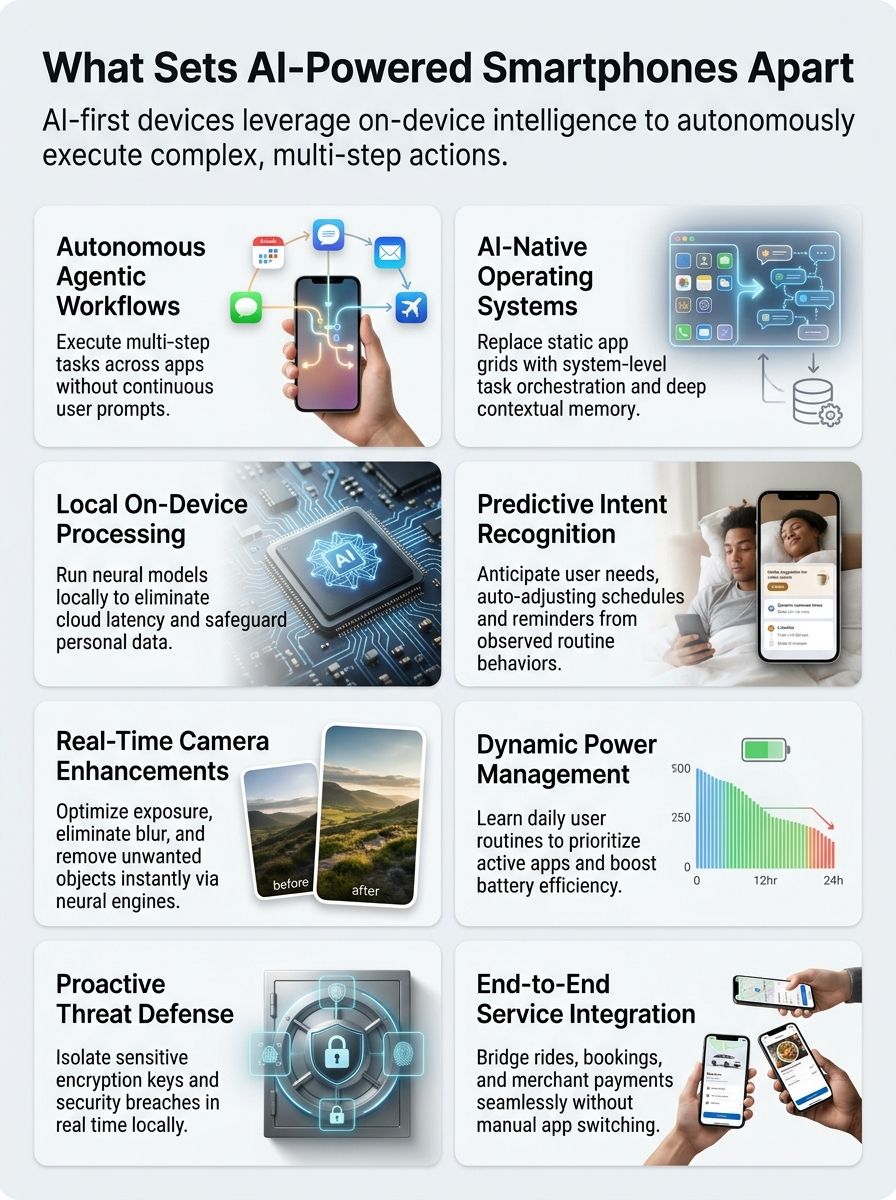
The Role of AI in Modern Smartphones
Artificial intelligence in modern smartphones already handles work that used to require separate apps, including camera tuning, voice transcription, translation, battery management, spam screening, and fraud signals. The difference is that most of these features react to one request at a time.
Apple phone users see this in computational photography, predictive text, Face ID, photo search, and Apple Intelligence tools that rewrite text or summarize notifications. Apple’s on-device foundation model is built for private tasks that can run locally, which can reduce delay and keep some requests off remote servers.
Apple’s 2025 Apple Intelligence update also opened its on-device model to developers, allowing supported apps to offer private AI features even when an internet connection is unavailable. For you, that means an AI feature is more useful when it can respond during a flight, in a weak signal area, or when you prefer not to send personal text to a cloud service.
- Camera AI recognizes scenes, balances exposure, reduces noise, and helps stabilize video before you edit anything.
- Battery AI studies charging and app-use patterns so the phone can reduce activity from apps you rarely need.
- Language AI can translate speech, summarize text, and help you draft messages without switching between several apps.
- Security AI can flag suspicious calls, unusual account behavior, phishing language, and spam patterns.
AI features are not automatically agentic. A phone that improves a night photo is using artificial intelligence, while a phone that plans a weekend trip, asks for approval, books the hotel, adds the reservation to your calendar, and drafts a message is acting more like an AI agent.
Agentic AI: A New Standard in Smartphone Technology
Agentic AI gives a smartphone the ability to work toward a goal through a sequence of approved actions. Earlier AI phones could answer, suggest, or generate content, while agentic AI phones can connect intent, memory, tools, and confirmation steps.
An AI-first phone is not defined by a chatbot icon. An AI-first phone puts artificial intelligence closer to the operating system so the phone can understand context, manage tool access, and move between compatible services with fewer manual app switches.
That is useful when the task has clear boundaries. It is risky when the task involves banking, health records, private messages, or purchases without a final review screen.
What are the key features of Agentic AI phones like StepX Neo?
Agentic AI phones like StepX Neo are presented as phones that use an AI agent to turn a spoken or typed goal into a multi-step workflow. The claimed Step Amoo agent works with Step AOS, an AI-focused software layer meant to coordinate services instead of leaving you to open each app yourself.
StepFun introduced StepX Neo in July 2026 as an AI-first mobile device, although U.S. pricing, carrier support, repair coverage, and long-term update terms should be confirmed before any purchase decision. That is a practical limit for American buyers because a phone can only complete a workflow if its regional apps, payment systems, and identity checks are supported.
- Intent recognition: The AI agent starts with a goal such as “plan my trip to Chicago,” rather than requiring separate commands for search, booking, calendar updates, and messages.
- Task planning: The autonomous intelligence layer breaks a goal into smaller steps and checks what data, apps, or permissions it needs.
- Tool access: The system can call approved app functions, maps, calendars, messaging tools, and payment services instead of relying on copied text.
- Memory: The phone can retain relevant preferences, such as a preferred airport or seat type, if you allow it to store that information.
- Confirmation controls: A trustworthy agent pauses before purchases, account changes, deleted files, or messages sent in your name.
- Local processing: Small language models can handle lighter tasks on the device, which can reduce delay and limit data transfers.
Step AOS enables agentic behavior by giving the AI agent system-level services for memory, tool routing, identity, and monitoring. Instead of treating each app as a sealed destination, Step AOS is described as a layer that can pass approved context from one tool to the next while recording what the agent did.
Third-party integrations decide whether this model is useful or just impressive in a demo. StepX Neo has been associated with services such as Alipay, Trip.com, Didi Chuxing, and Meituan in China, so a U.S. buyer should expect different results unless equivalent local partners support bookings, payments, ride requests, and account verification.
How does agentic AI improve multi-tasking and recognize user intent?
Agentic AI improves multi-tasking by connecting related actions under one stated goal. An AI agent can ask follow-up questions once, then use the answers to prepare a calendar event, compare options, draft a message, and present a final approval step.
Proactive agents use context, but context should never mean unlimited access. If you allow an agent to read email, calendars, contacts, and messages, review whether the permission is needed for the feature you want and turn it off when the task ends.
Apple Intelligence, Google Assistant, Google Gemini, OpenAI tools, and other large language models can help with language and planning, but a model alone cannot safely act across apps. The phone also needs app permissions, identity checks, transaction limits, and an activity history that shows what the AI agent changed.
Practical rule: Treat an AI agent like a new assistant with limited authority. Start with low-risk jobs such as summarizing notes or drafting emails before allowing travel reservations, purchases, or account changes.
What kinds of multi-step tasks can agentic AI phones autonomously complete?
Agentic AI phones can complete multi-step tasks when each service exposes the right tools and you approve the needed permissions. The best first uses are routine, reversible jobs where you can inspect the final result before anything is sent or paid.
- Travel coordination: Compare flights, suggest hotels, prepare an itinerary, place events on a calendar, and draft confirmation messages.
- Scheduling: Find common meeting times, propose options, create an event, and prepare a follow-up email for your approval.
- Message management: Sort low-priority messages, summarize long threads, draft replies, and flag items that need a human decision.
- Expense organization: Categorize receipts, prepare a spending summary, and assemble notes for an accountant without moving money.
- Photo organization: Group images by trip or event, suggest edits, remove duplicates, and prepare a shared album.
- Support requests: Collect order details, draft a support message, track a ticket, and alert you when a company replies.
Agentic AI should not independently negotiate contracts, transfer funds, change medical instructions, release software code, or approve legal documents. Those tasks involve consequences that go beyond a normal assistant feature, so your phone should stop for a clear review.
Industry stories often connect agentic AI with companies and figures such as Carl Pei, Alphabet, Tencent Holdings, Arvind Krishna, Kaoutar El Maghraoui, Shobhit Varshney, and Ashutosh Shrivastava. The useful takeaway is less about celebrity names and more about the shared technical problem: phones need reliable app access, local models, privacy controls, and visible user consent before agents can move from demos into daily use.
Which companies and products are leading in agentic AI smartphones?
Samsung, Apple, Google, Deutsche Telekom, and StepFun represent different paths toward AI-first phones. Samsung and Google focus on Android features and system integrations, Apple focuses on tightly controlled hardware and software, while Deutsche Telekom has explored an app-light assistant model with Perplexity.
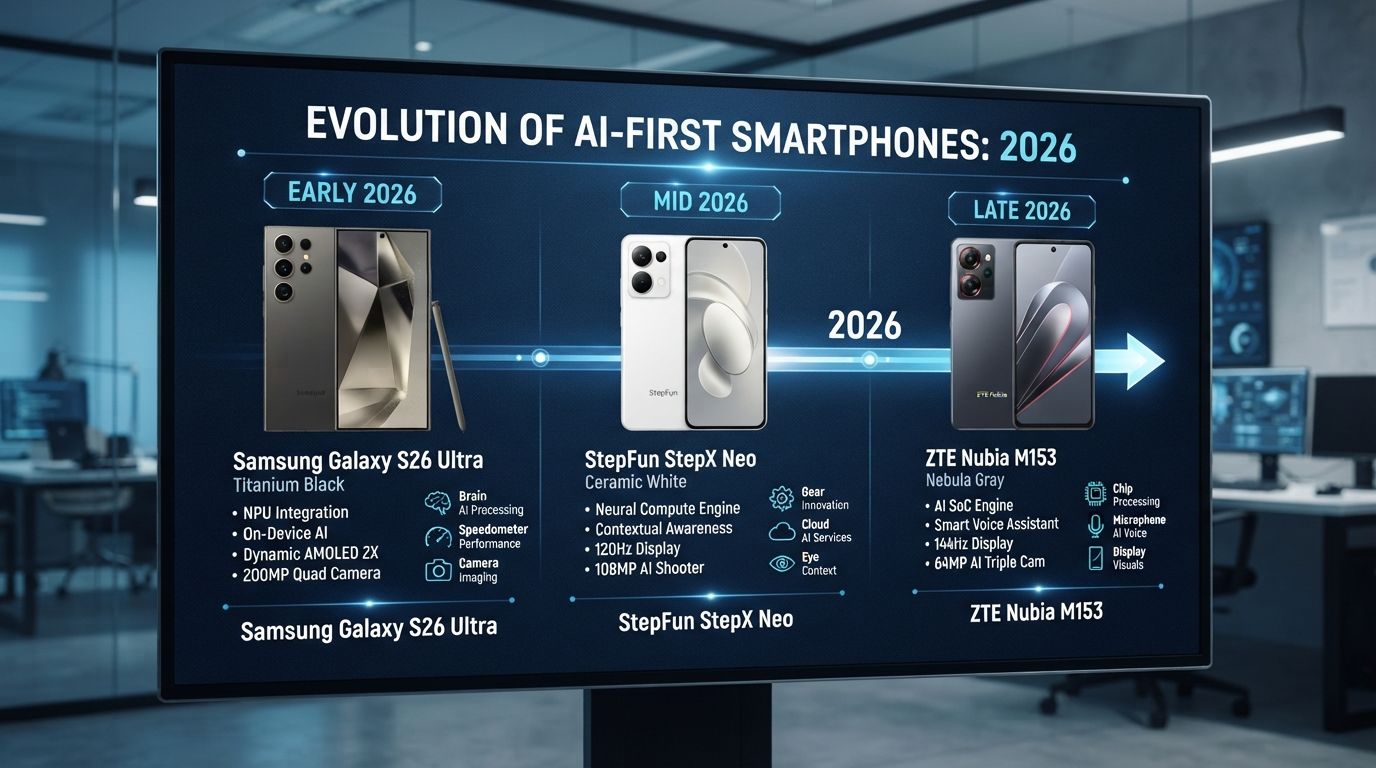
| Company | Product | Launch / Year | Agentic AI Highlights | Key Hardware & Support | Concepts & Tools |
|---|---|---|---|---|---|
| Samsung | Galaxy S26 Ultra | 2026 | Galaxy AI adds proactive help, cross-app assistance, and Call Assist features that can screen or manage calls. | Samsung lists 7 generations of operating system upgrades and 7 years of security updates. The Galaxy S26 Ultra supports up to 75% wired charging in 30 minutes with compatible charging equipment. | Galaxy AI, Gemini integrations, on-device processing, Samsung account controls. |
| StepFun | StepX Neo | July 2026 | Presented as an agentic AI smartphone with intent-aware, multi-step task handling. | U.S. price, availability, supported carriers, and update policy should be verified before purchase. | Step AOS, Step Amoo, agentic phone architecture, local model orchestration. |
| ZTE | Nubia M153 | 2026 | Associated with AI-focused user control and intent recognition concepts. | U.S. retail availability, compatibility, and long-term software support need confirmation. | Device-level AI controls, privacy settings, edge AI runtime. |
| Deutsche Telekom | AI Phone with Perplexity | Concept shown at Mobile World Congress 2024, consumer devices followed in Europe | Assistant-led search, booking, translation, and task handling without relying on a conventional app-first home screen. | Availability and pricing vary by market rather than following a U.S. carrier model. | Perplexity assistant, Magenta AI, carrier integration, conversational search. |
Samsung’s Galaxy S26 Ultra is a clear example of a mainstream phone moving toward proactive AI. Samsung announced the series in February 2026 and lists 7 years of software and security support, which matters more than a flashy launch feature if you plan to keep the phone for several upgrade cycles.
Integration of AI into Operating Systems
AI integration works best when the operating system can manage models, memory, permissions, and app actions in one place. Apple’s on-device machine learning model research shows why local models matter: the phone can respond quickly while keeping some personal context on the device.
Android and iOS are still the dominant foundations for U.S. phones. Most AI-first phones are Android-based or use an Android-derived base with proprietary AI services layered above it, while Apple builds Apple Intelligence directly into iOS and its own hardware stack.
What is the difference between AI-native operating systems and traditional app grids?
AI-native operating systems place AI coordination near the system core, while traditional app grids make you open and manage each app yourself. An AI-native OS can still show familiar app icons, but it adds a layer that can interpret requests and route approved work across compatible tools.
| Aspect | AI-native OS | Traditional App Grid |
|---|---|---|
| Design Goal | Coordinates AI applications, permissions, and system services around a user goal. | Organizes separate apps that users open and control one at a time. |
| Task Management | Can plan related actions, manage context, and send work to approved tools. | Leaves task order and information transfer largely to the user. |
| Adaptability | Can respond to calendar context, location settings, device state, and stated preferences. | Uses fixed app interactions with limited system-wide coordination. |
| Crash Resilience | Can monitor AI tasks, pause failed steps, and request user input before continuing. | Usually treats each app failure as a separate issue for the user to resolve. |
| Multi-step Automation | Can coordinate supported apps and system functions for agentic workflows. | Requires manual switching or app-specific shortcuts. |
| Privacy and Performance | Can route suitable requests to local models and limit cloud use based on the task. | Depends on each app’s own permissions and cloud processing choices. |
| User Experience | Starts with a goal, then proposes a sequence of actions and approvals. | Starts with an app, then requires you to decide each next action. |
| Support for Agentic AI | Provides memory, tool access, identity checks, logs, and user controls for agents. | Offers fewer built-in ways for an agent to work across app boundaries. |
What operating system do agentic AI phones like StepX Neo use?
StepX Neo uses Step AOS, according to StepFun’s product positioning, while other agentic AI phone concepts may use Android-based software, proprietary layers, or AI-focused frameworks often called Agent OS or AIOS. No single operating system standard currently defines every agentic phone.
Step AOS is described as a system with an agent layer above core phone services. That structure gives the AI agent a place to hold temporary context, select approved tools, verify identity, monitor task status, and show activity records to the user.
- Memory Manager: Retains allowed context, such as task details and preferences, then clears or limits it based on your settings.
- Tool Manager: Routes requests to compatible apps, local models, APIs, and device features.
- Identity Manager: Separates accounts and verifies which profile can approve a purchase, message, or data request.
- Observability tools: Record task steps so you can see what the AI agent attempted and where a task failed.
- Governance controls: Apply rules for permissions, spending thresholds, data access, and required confirmations.
For Apple phone users, the comparable idea is not a separate Step AOS-style product. Apple Intelligence works through iOS, Apple’s foundation models, app intents, Shortcuts, and privacy systems that decide whether work happens on-device or through Private Cloud Compute.
AI-Driven Features That Stand Out
AI-driven features stand out when they save time without making you surrender control. The strongest features run quickly, state what data they need, and let you undo or edit the result.
How does on-device AI improve privacy and processing speed?
On-device AI improves privacy and processing speed by completing suitable work inside the phone instead of sending every request to a remote server. Local processing is useful for dictation, photo edits, personal writing help, and image recognition when you want a quick response or have limited connectivity.
Apple’s foundation-model work describes a roughly 3-billion-parameter on-device model for Apple Intelligence. Apple has also reported that its earlier on-device model could generate about 30 tokens per second on iPhone 15 Pro hardware, which explains why short writing and summarization tasks can feel immediate rather than delayed.
On-device processing does not mean every AI request stays local. Complex requests may still use private cloud infrastructure or another online model, so read the feature description before assuming that a task never leaves your phone.
- Use local options for notes, photo edits, and personal text when available.
- Check whether a feature says it uses cloud processing before sharing private documents.
- Keep iOS or Android security updates current, because AI features still rely on the same device protections as other apps.
- Turn off access for contacts, calendars, location, or microphones when an AI feature no longer needs it.
How do AI-powered cameras enhance images in real time?
AI-powered cameras enhance images in real time by recognizing scenes and adjusting exposure, color, focus, noise reduction, and stabilization before you view the final frame. The phone can also combine information from several frames to recover detail in difficult light.
NexOptic’s ALIIS image-processing technology is one example of the broader push to improve resolution, telephoto detail, low-light performance, and file efficiency through computational processing. The value for you is practical: cleaner handheld shots and smaller files can make sharing, storage, and streaming easier.
Apple, Samsung, Google, and other phone makers also use generative AI for object removal and photo cleanup. Treat those tools as edits, not documentary truth, especially when you are preserving family events, receipts, evidence, or work records.
Camera check: Review the edited image at full size before sharing it. Object removal can alter edges, shadows, text, and background details that look acceptable on a small screen.
Comparing AI Assistants Across Platforms
Apple Intelligence, Galaxy AI, and Google Gemini differ most in where they run, which services they can reach, and how much they ask you to approve. The best choice depends on the phone ecosystem you already use and the data you are comfortable sharing.
How does Apple Intelligence compare to Galaxy AI and Google Gemini?
Apple Intelligence fits Apple phone users who want AI tools tied closely to iOS privacy controls and Apple apps. Galaxy AI suits people who want extensive photo, call, and Android productivity tools, while Google Gemini is a natural fit for users who rely on Google Search, Gmail, Maps, Calendar, and Android services.
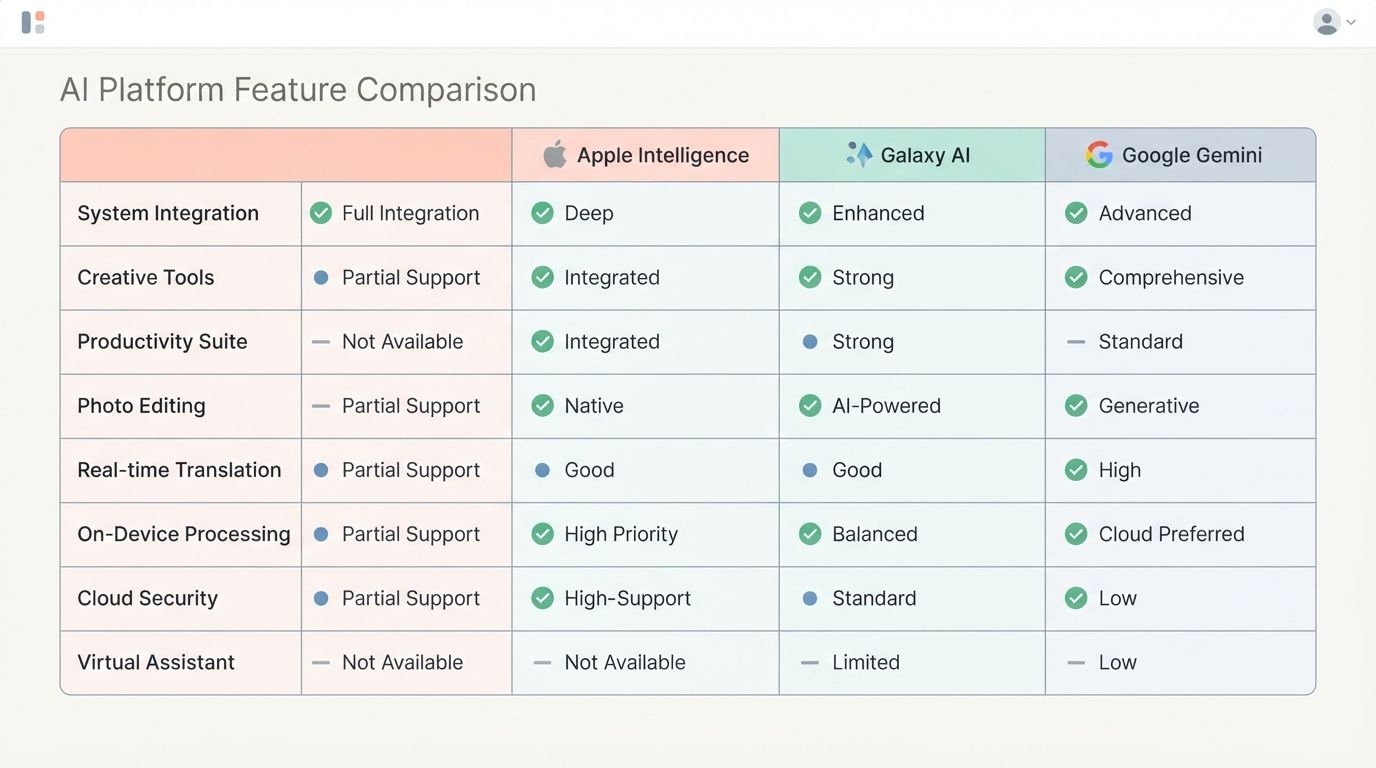
| Feature | Apple Intelligence | Galaxy AI | Google Gemini |
|---|---|---|---|
| Release date | Released with supported iPhone features beginning in October 2024, with new capabilities continuing through 2025 and 2026. | Launched with the Galaxy S24 series in January 2024 and expanded across newer Galaxy devices. | Works across Android and Google services, with feature availability varying by device and region. |
| Primary focus | Privacy controls, writing tools, visual intelligence, and Apple ecosystem integration. | Photo editing, translation, call tools, search support, and Galaxy productivity features. | Conversation, search context, multimodal requests, and Google service connections. |
| Key features | Writing tools, notification summaries, image creation, live translation, and app intelligence. | Generative photo tools, live translation, call assistance, note tools, and Circle to Search support. | Research help, voice interaction, image input, search-aware answers, and connected Google tasks. |
| Privacy and processing | Uses on-device processing and Private Cloud Compute for requests that need more capacity. | Uses a mix of on-device and cloud features, depending on the task and chosen settings. | Uses device and cloud processing depending on the feature, device, and account settings. |
| Device compatibility | Requires a supported newer iPhone model for the full Apple Intelligence feature set. | Varies by Galaxy model and feature, with newer flagships receiving the widest set of tools. | Available across many Android phones, with Pixel devices often receiving new features first. |
| Cost model | Core Apple Intelligence features are included on supported devices. | Core Galaxy AI features are included on supported devices, while future premium services may vary. | Core features are available broadly, while advanced model access can depend on a paid Google plan. |
| Performance in daily use | Works best for users who keep messages, photos, notes, and apps inside Apple’s ecosystem. | Works well for people who want quick editing and Android task assistance. | Works well for users who already depend on Google services throughout the day. |
| Best for | Apple phone users who value local processing and tight iOS integration. | People who want broad AI features on a flagship Android phone. | People who use Google services heavily and want conversational help across them. |
The Future of AI-Powered Smartphones
The future of AI-powered smartphones is less about adding another chatbot and more about setting safe limits for agents that can act. AI-first phones will earn trust when users can see permissions, review task histories, revoke access, and stop an action before it becomes permanent.
How do AI-first phones compare to standard smartphones in everyday use?
AI-first phones reduce manual switching by helping you move from a goal to a completed task across supported apps. Standard smartphones can run AI features too, but they usually leave the planning and coordination work to you.
AI-first phones can sort notifications, prepare replies, summarize long documents, translate speech, organize photos, and suggest calendar actions. Those benefits are strongest for repetitive work, while a standard smartphone remains the better choice if you prefer to handle each step yourself.
| Everyday Need | AI-First Phone | Standard Smartphone |
|---|---|---|
| Travel planning | Can propose a plan across compatible search, booking, calendar, and messaging tools. | Requires you to search, compare, book, and organize each step manually. |
| Email and messages | Can summarize threads, draft replies, and suggest follow-up tasks. | Can offer predictive text and basic smart replies. |
| Photos | Can organize images, suggest edits, remove distractions, and create collections. | Can apply computational photography and manual editing tools. |
| Privacy choices | Needs more careful review because an AI agent may request wider access. | Usually limits access to the permissions requested by each separate app. |
AI-first phones also create a tradeoff. More personalization can require more context from your calendar, messages, locations, and app activity, so the smart move is to allow only the data needed for the job you actually want completed.
How much does an AI-first phone cost?
AI-first phone pricing ranges from lower-cost carrier devices to premium flagships, but the AI label does not tell you the true cost. You need to check the handset price, required subscription, carrier lock, storage tier, accessory needs, and how long the manufacturer will provide operating system and security updates.
Deutsche Telekom’s T Phone 3 launched in European markets as a lower-cost AI-focused option, while flagship AI phones such as Samsung’s Galaxy S26 Ultra sit in a premium category. StepX Neo does not have a confirmed U.S. retail price in the information available here, so treat any claimed cost as unverified until StepFun publishes U.S. sales details.
- Compare the total cost over 3 to 7 years, not only the launch price.
- Ask whether advanced AI features need a subscription after a trial period.
- Confirm whether the AI tools work in the United States and with the apps you use.
- Check battery replacement, repair access, carrier bands, and software-update commitments.
Conclusion
AI-powered smartphones set themselves apart by moving artificial intelligence closer to the operating system, where it can help plan tasks, handle approved tools, and keep more work on the device. For Apple phone users, Apple Intelligence already shows the value of a controlled mix of on-device models and private cloud processing.
AI-first phones are worth considering if you want less manual work with messages, photos, translation, calendar planning, and travel preparation. AI-first phones are not the right fit if you do not want an AI agent to access personal context or if you expect every task to work without review.
The strongest agentic AI experience is not the one that acts most often. The strongest agentic AI experience is the one that clearly shows what it knows, which app it wants to use, what it plans to do next, and how you can stop it.
StepFun’s StepX Neo and Step AOS point toward a model where an autonomous intelligence layer coordinates tasks across compatible services. That idea is promising, but U.S. buyers should verify real availability, price, supported apps, payment compatibility, carrier coverage, privacy terms, and software support before treating any overseas concept as a practical daily phone.
Samsung’s Galaxy S26 Ultra, Google Gemini, Deutsche Telekom’s AI Phone work, and Apple Intelligence show that the industry is moving in the same direction. Each platform is trying to reduce app switching by helping the phone understand intent, manage context, and suggest the next useful action.
On-device intelligence matters because it can keep suitable tasks local, respond quickly, and remain useful when connectivity is poor. Small language models are especially helpful for routine writing, classification, photo, and language tasks that do not need the full reach of a large cloud model.
Privacy still decides whether an AI agent earns a place on your phone. An AI agent that can read messages, place orders, book reservations, or access payment tools needs narrow permissions, visible activity logs, spending limits, and a clear way to revoke access.
Use a cautious rollout for any new AI agent. Start with summaries, drafting, translations, and photo organization, then move to calendar actions or travel planning only after you understand the review screens and account permissions.
AI-powered smartphones offer real value when the phone saves time without hiding its work. Choose a vendor that publishes update commitments, explains where processing happens, provides clear privacy controls, and gives you an easy way to undo or reject an agent action.
For Apple phone users and AI users who value speed and local controls, the new class of AI-powered smartphones can be useful today. The best choice is the phone that gives you capable AI features while keeping you firmly in charge.
Read more artificial intelligence articles at ClichéMag.com
Images provided by Deposit Photos, BingAI, Adobe Stock, Unsplash, Pexels, Pixabay Freepik, & Creative Commons. Other images might be provided with permission by their respective copyright holders including AI generators.
References
- https://ipmckart.com/blog/how-ai-features-are-changing-modern-smartphones?srsltid=AYCX9vITIg80qG-Xru1WbAbqFV1eAx1XU9E0BiXEKsMmfIG0o1zdprji (2026-09-16)
- https://www.linkedin.com/pulse/how-ai-revolutionizing-mobile-phones-complete-guide-rejoicehubllp-2auuc
- https://global.chinadaily.com.cn/a/202607/15/WS6a56f04aa310986e2b4655a1.html (2026-07-14)
- https://medium.com/aimonks/agentic-ai-trends-in-2025-the-rise-of-autonomous-digital-workers-3f47868fca3a
- https://www.facebook.com/ibrahim.yusuf.774402/posts/the-gold-standard-of-agentic-ai-smartphonesthe-verdictsamsung-didnt-just-iterate/1260878696250408/
- https://www.facebook.com/cointelegraph/posts/-new-china-is-pushing-ai-smartphones-as-zte-unveiled-its-first-agentic-ai-phone/1347616180878540/
- https://www.academia.edu/165224491/AI_Native_Operating_Systems_Need_a_Fifth_Category_The_Semantic_OS_Why_AIOS_rabbitOS_VAST_AI_OS_and_NVIDIA_Dynamo_Still_Dont_Describe_What_Happens_Inside_the_Context_Window
- https://pub.aimind.so/ai-agents-are-the-new-apps-wheres-the-operating-system-56603175daca
- https://www.solulab.com/ai-in-mobile-phones/
- https://www.canoetripping.net/threads/artificial-intelligence-ai-may-improve-photo-quality.114713/ (2020-07-28)
- https://www.yournavi.com/posts/apple-intelligence-vs-galaxy-ai
- https://wpdemo.wensolutions.com/wens-press-pro-sixth/2026/05/15/the-future-of-ai-powered-smartphones/ (2026-05-15)


