
Last Updated on September 16, 2026 by Cliche
It might sound dramatic, but it doesn’t make it any less true: bar stools completely change the functionality, flair, and flexibility of your kitchen, from fine (okay) to fine (elegant, exquisite).
To get there, though, you’ll need to kit out the heart of your home with a set of compatible kitchen bar stools. Seating that looks the part, to be sure, but equally opens up the practical possibilities of the space for dining, food prep, relaxation, hosting, and enjoying your new Kitchen Bar Stools.
To help you narrow down the options to something more manageable, I’m here to walk you through the essential deciding factors. All you have to do is answer these questions.
What Are Your Red Lines & Requirements?
Bar stools work for all manners of home: the chic, open-plan apartment, townhouse rentals, seaside holiday cottages, new build kitchen-diners and everything in between. Yet there’s no blanket solution.
Instead, you’ve got to work out which bar stools satisfy the specific quirks of your lifestyle, in the here and now, yes, but also in the future. These are a serious investment, after all!
So, first, look at your current kitchen setup and consider the gap between what you love about it and what’s missing. Maybe you’re fond of the quirky footprint of your tiny kitchen, but you feel that your peninsula is wasted as a glorified chopping board. Pop a backless barstool beneath, and the functionality is tripled.
Ask yourself:
- What height is the adjacent surface? A comfortable seat height is widely agreed to be around 25–30 cm below the tabletop. Likewise, leave 70cm minimum behind the chair for unimpeded traffic flow.
- Who is using the chair, and in what capacity? If you expect long stints at the breakfast bar sat in front of your laptop, a plush, well-cushioned seat is non-negotiable.
- How much upkeep are you willing to put up with? Cleaning wood, acrylic and metal bar stools is a seconds-long job, whereas leather and velvet require a bit more care.
- Do you have a chaotic household home to pets, younger children or just clumsy adults? Might you consider something with a textured weave that masks minor marks?
- Is visual clutter a big problem for you? Then, sleek silhouettes with fewer ornamental details are probably your best bet.
- Is there a particular material you don’t get on with in a tactile sense? Don’t cave to the trends or whims of algorithms; trust your instincts. You know yourself much better.
- Oooh, the budget question – how much are you willing to shell out for your new bar stools? They don’t need to cost the earth, but do know that, often, you get what you pay for. My top tip is to always corroborate the price tag with customer reviews.
- Are you done with buying twice? Quality bar stools aren’t machine-produced or made from cheap materials; they’re handcrafted, organic and gain distinctive, value-accruing patina over time.
What Does Your Interior Need?
So, those were your particular needs, but what is your kitchen crying out for?
Well, if the interior is feeling ‘off’ or unfinished, that’s often a sign that something’s wrong with the layout and flow of the space. Swapping out bulkier dining chairs and tables with an integrated island and stools you can tuck away at a moment’s notice is a ridiculously streamlined solution. As is rethinking the size of your seating.
Bulkier stools work best in spacious environments to prevent the room from feeling cavernous, while pint-sized kitchens need all the clearance for circulation they can get.
Say you’re working with an open-concept interior where your choices are limited by the existing fixtures; here a freestanding island would need to be paired with stools substantial enough to ‘anchor’ the feature. Contrast this with a banquette nook nestled in a corner. The built-in bench would be easily dwarfed by hefty, wooden stools, but stylishly complemented by those with a lightweight frame and pared-back silhouette. Here, the choice is just as much a question of scale and proportionality as style.
Will You Go With or Without a Backrest?
This is a fundamental question, as it sets the parameters for what you can and can’t do with the stools, not to mention the influence it has on the aesthetics. So, let’s compare the pair side by side.
Stools with Backs…
Are unmistakably timeless, carving out a traditional, back-to-basics feel in your kitchen that only deepens when these comfy seats are the upholstered varieties. A veritable treat for the spine, the tall back envelops the sitter in what can only be described as a hug, supporting better posture during mealtimes.
The downside, though, is that the backrest will always be visible above the height of the counter, so not exactly the best choice if you want visual noise at a minimum. Then there’s the bulkier frame to contend with when you move them about.
Backless Stools…
Present the more modern, minimalist solution to your island’s seating, the draw being their especially compact footprint. Although they have a limited sense of history to them, the clean, flowing aesthetic works well amidst transitional, mid-century, eclectic and industrial-leaning kitchens precisely because they’re a little less distinctive. They take on the personality of the room.
Again, these bar stools are fallible. Since they lack a backrest to cradle the spine, it can be uncomfortable to perch on them for extended periods, and for the same reason they’re not the safest choice for children or elderly folks with limited mobility. On the upside, they can be tucked out of sight when not in use; perfect if you need to recoup the inches in an open-plan space.
Do Any Other Bar Stool Ergonomics Catch Your Eye?
Besides the back vs no back debate, it pays dividends to consider all the ergonomic features at your disposal, particularly if you plan to grow old alongside these pieces.
Mull over…
- Height adjustability and swivel action
- The size and importance of armrests
- Deeper seats for a lounge-like feel vs the structured, posture-improving shape of a narrower stool
- Whether you need a support to rest your tired feet on
- How firm and/or cushioned you want the seat to be
- Which textures are more comforting to the senses
- If you need the frames to be lightweight so you can reposition them around the room
Which Is More ‘You’, a Warm, Homely Vibe or a Sleek, Editorial Aesthetic?
Two barstools can share the exact same measurements and materials yet create vastly different ambiences. One cutting-edge, cool, light-touch and unexpected; the other warming, grounded, nostalgic, friendly.
This is due to various factors. The first being the familiarity effect. We’re all familiar with the traditional saddleback barstool, with carved spindle legs crafted from oak. But has everyone seen a curved rattan-back stool with a plump leather seat and tapered legs? I think not.
The homely factor is also amped up via:
- Rounded shapes
- Thicker legs or bulky frames
- An enveloping back
- Plush cushioning
- Heavier textures such as chunky boucle or warm-tone colours
- Traditional, staple silhouettes
Contemporary and eclectic kitchen bar stools have to thank:
- More angular or sculptural forms that build surprise
- Flatter, shinier materials
- Slimline frames, with open or no backs
- Mixed materials, which bring contrast and focal points into the design.
Of course, there are designs that straddle both worlds, tacking on an interesting twist to something well-known. I’m thinking transitional styles or contemporary reimaginings of mid-century modern silhouettes.
From traditional tub stools and saddle-seat options to substantial rounded models with a pedestal base, it’s all about listening to your gut and picking something you instinctively gravitate to whilst fulfilling all of your requirements.
How Will You Style Your New Bar Stools In Situ?
Sometimes working backwards from your kitchen island, peninsula, countertops, or dining table is the most sensible plan. That way, you can be 100% sure that they will tie into your broader theme.
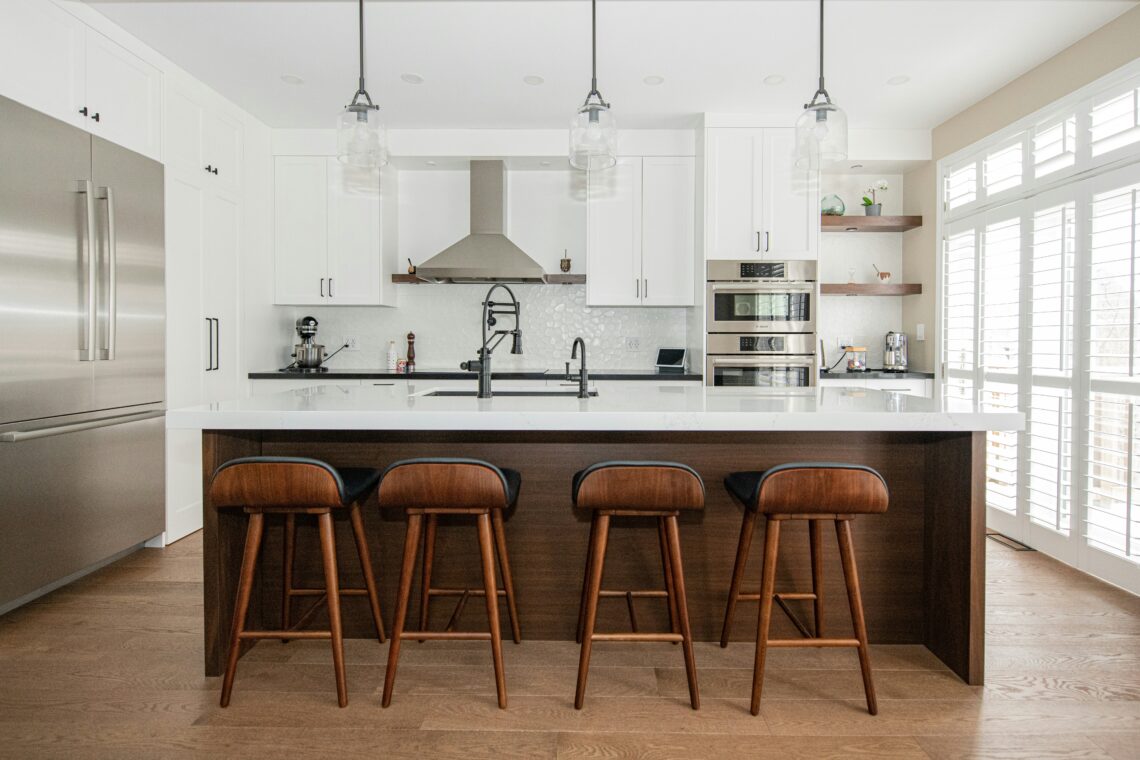
Begin by noticing motifs you can match or offset with the seating. Personally, I’m all for mixing and matching bar stools, as long as they share a visual throughline. If you’re capping off a flowing, waterfall-style island in granite, I’d go for bar stools that share that luxe, modern look; something with a good sheen. For a freestanding butcher’s block or shaker-style table, you could complement the toasty timber tones with something equally textured: another wood or a heritage leather flecked with tiny dimples.
A good approach is to view the bar stools as another layer of the décor. You want to accumulate layers of complementary colours and establish depth through texture, even if you’re not envisioning your barstools as an attention-grabbing focal point.
Conclusion: Those Were the Key Questions. Do You Have Your Answers?
As it turns out, choosing your new kitchen bar stools doesn’t have to be a palaver. Not at all. Well, provided you look at each consideration systematically and through a lens of real-world living, because you’re outfitting your actual kitchen, not an idealised version of it. And now that you know that, you can make your space functional, flexible and full of flair. Ah, we’ve come full circle.
Read more home decor articles at ClichéMag.com
Images provided by Deposit Photos, BingAI, Adobe Stock, Unsplash, Pexels, Pixabay Freepik, & Creative Commons. Other images might be provided with permission by their respective copyright holders including AI generators.