
Last Updated on April 30, 2026 by Cliche
Routes That Outlast the Reasons for Them
Some rail lines feel newer than the cities they serve. Others feel older than the names on the stations. Central Europe has a way of turning movement into inheritance, passing routes forward even as empires thin and borders rearrange themselves. Travel here doesn’t behave like a modern convenience. It feels habitual, embedded, something that has been rehearsed for centuries and refined rather than reinvented. Steel tracks follow logic laid down long before speed mattered — connecting administrative centres, trade corridors, cultural capitals that still recognise one another even when politics insists otherwise.
Speed That Stays in the Background
Modern trains move quickly through this landscape, but speed rarely becomes the story. The Railjet slides into stations with the confidence of something that doesn’t need to prove itself. Acceleration is smooth enough to disappear. Interiors remain composed. Outside, the land reorganises slowly — suburbs thinning into open fields, fields interrupted by towns that register just long enough to suggest continuity rather than destination. For travellers booking high-speed train tickets, the appeal often isn’t velocity itself, but how little effort that velocity requires. Distance collapses without drama, leaving space for attention to wander instead of brace.
Rails as the Quiet Constant
Across the route, rail travel becomes the stabilising element. Trains arrive often enough that schedules loosen. Stations behave like shared spaces rather than thresholds. You’re rarely urged to hurry. You’re rarely left waiting long enough to feel stalled. This reliability alters how distance feels. You stop planning every step. You respond instead — to a seat by the window, to a stretch of land that holds your attention longer than expected, to moments when nothing much happens at all.
A Corridor Shaped by Repetition
The route between Austria and the Czech Republic has been travelled often enough to feel settled. Rivers appear beside the tracks, then drift away. Forests gather and loosen again. Borders no longer interrupt the rhythm, but the memory of them lingers in architecture and spacing. Moving north, the land feels patient, familiar with being passed through. By the time you reach the Vienna to Prague train corridor, the sense of transition has softened. You’re not crossing into something new so much as sliding into another register of the same shared geography.
Vienna’s Measured Composure
Vienna opens itself carefully. Streets widen. Buildings give one another room. The city carries the imprint of ceremony without insisting on it. Imperial order remains visible in layout and proportion, but it no longer directs behaviour. Museums sit beside shopping streets. Palaces frame parks used for everyday wandering. The station feels less like a gateway and more like an extension of the city’s rhythm — a place where movement passes through without needing to be marked.

Landscape as Continuity Rather Than Scenery
Between cities, the view resists spectacle. Hills rise without announcement. Villages appear briefly and dissolve again. Nothing performs for the window. The landscape behaves as it always has — present, functional, unconcerned with being admired. You stop waiting for the moment worth photographing. Repetition takes over. Fields echo earlier fields. Rooflines repeat in different arrangements. Travel becomes less about looking and more about recognising.
Prague’s Inward Turn
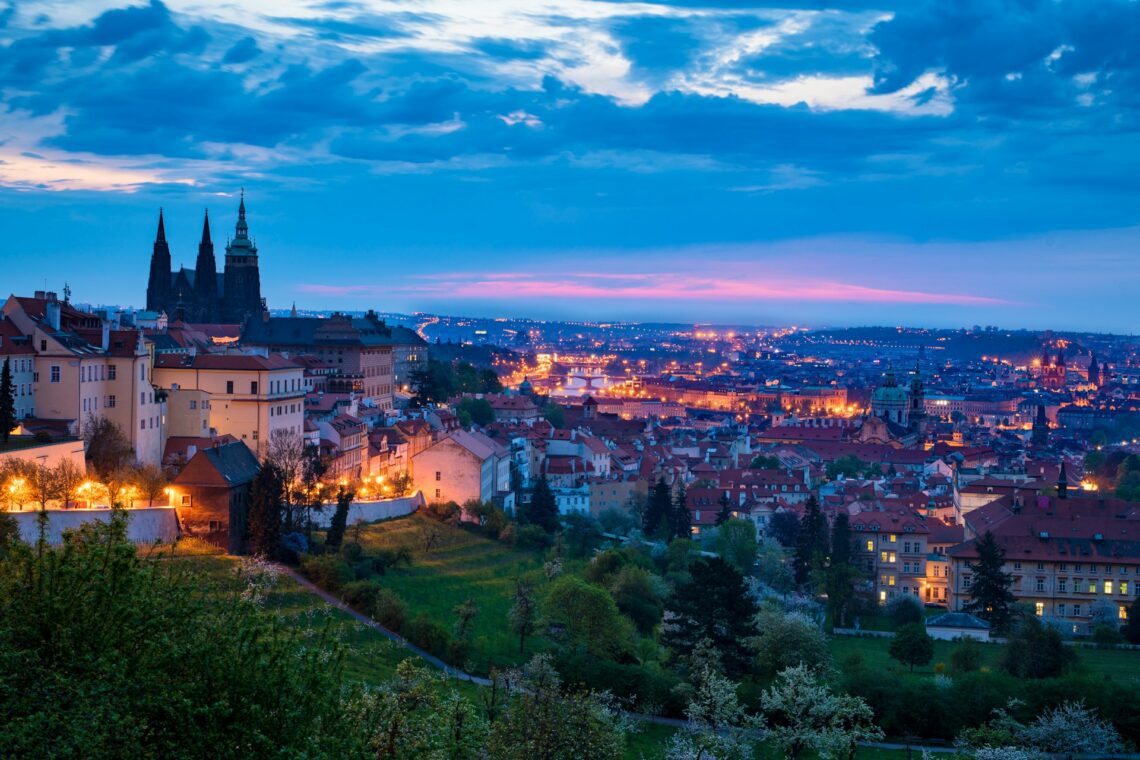
Prague doesn’t arrive all at once. It gathers itself gradually, density increasing without a clear edge. Streets curve inward. Ornament lingers longer here, stone layered with detail that feels accumulated rather than designed. The Hradčany skyline appears not as a reveal, but as a steady presence above the city — visible from angles you didn’t expect, then gone again as streets narrow and bend. The castle doesn’t dominate. It watches. Daily life continues beneath it, trams threading through routines that pay little attention to grandeur.
The City Seen From Motion
Arriving by rail gives Prague a particular texture. You don’t step into the city. You’re absorbed by it. Platforms release you into streets that already know how to carry people. Cafés fill and empty in cycles. Bridges repeat their crossings patiently. The river doesn’t divide so much as organise. History here doesn’t present itself as something completed. It remains active, adjusted around, lived alongside.
What Overlaps Instead of Ending
Later, the journey doesn’t return as a sequence of places. Vienna and Prague blur at the edges, connected less by geography than by rhythm. Stone façades, river light, steel tracks, measured speed — they overlap rather than separate. The route doesn’t resolve into a story about progress or connection. It remains unfinished, loosely held. What stays is a sense of continuity — of movement that outlived its original purpose and still quietly organises life along its path, without asking to be noticed.
The Route After It Disappears
After some time, even the idea of the route itself fades. You don’t recall where speed increased or slowed, or which stretch of land belonged to which country. What remains is a sensation — of being carried without effort, of moving through places that didn’t ask for interpretation. The rails stop feeling like connectors and start feeling like something quieter, almost internal: a way distance learned to behave. The journey doesn’t close. It loosens, staying with you as a background rhythm, long after the trains themselves have slipped out of view.
Read more lifestyle and travel articles at ClichéMag.com
Images provided by Deposit Photos, BingAI, Adobe Stock, Unsplash, Pexels, Pixabay Freepik, & Creative Commons. Other images might be provided with permission by their respective copyright holders.