
Last Updated on January 16, 2026 by Cliche
Norway’s west coast feels shaped by decisions made slowly. Mountains rise where they must. Water cuts inward with patience. Settlements appear where the land allows them, not where convenience suggests they should be. The result is a landscape that doesn’t ask to be admired so much as approached with attention.
What defines this stretch of coast is contrast without conflict. Peaks rise sharply, but they don’t overwhelm. The Atlantic presses close, yet never feels chaotic. Beauty here is not ornamental — it’s structural, built from geology, weather, and the long habit of adapting rather than resisting.

Moving West Without Disruption
Travel across Norway works best when it feels like continuation rather than transition. The country’s infrastructure supports this instinct, allowing movement to unfold at a pace that matches the landscape.
For travellers planning to book high-speed trains, Norway offers something different from speed for its own sake. Efficiency exists, but it never fractures experience. Time onboard becomes part of the journey rather than something to endure.
Where the Land Tightens in Oslo
Oslo sits slightly apart from the drama often associated with Norway’s west. It is measured, restrained, and deliberately composed. Yet it functions as an important threshold — the place where the country’s interior logic begins to tilt toward the coast.
The city’s relationship with nature is subtle rather than spectacular. Forests edge close to neighbourhoods. Waterlines shape movement. Even modern architecture tends to stay low, allowing space to breathe.
Oslo doesn’t compete with the landscapes beyond it. It prepares you for them.
When Elevation Shapes Awareness
Taking the Oslo to Bergen trains demonstrates Norway’s balance clearly. The route doesn’t rush through terrain — it reveals it, steadily and without emphasis.
As the train climbs westward, the landscape tightens. Valleys deepen. Snow appears and disappears depending on altitude and season. Light shifts more frequently, forcing attention outward.
This elevation isn’t dramatic in a cinematic sense. It’s incremental. You notice the change because it continues, not because it announces itself. The journey teaches patience through repetition.
By the time the coast approaches, awareness has already adjusted.
Atlantic Presence in Bergen
Bergen feels held by its surroundings. Mountains press close. Water opens outward. The city exists in negotiation with both.
Unlike inland centres, Bergen doesn’t attempt separation from the elements. Rain is expected. Wind is normal. Light arrives in fragments. This acceptance shapes the city’s character — practical, adaptable, and quietly resilient.
Buildings cluster for shelter rather than display. Streets curve in response to terrain. Life continues regardless of conditions, not in defiance of them.
Fjords as Structure, Not Scenery
The fjords along Norway’s west coast are often described as dramatic, but that word only captures surface reaction. Their deeper quality lies in how they organise space.
Water becomes corridor. Rock becomes boundary. Movement follows the land’s logic rather than interrupting it. Villages appear where access is possible, not where views are best.
These fjords don’t frame the landscape. They are the landscape — active, shaping, persistent.
Coastal Villages and Practical Beauty
Small settlements along the coast feel provisional by design. Houses face water for orientation, not aesthetics. Boats matter more than roads. Daily life responds to tide and weather rather than schedule.
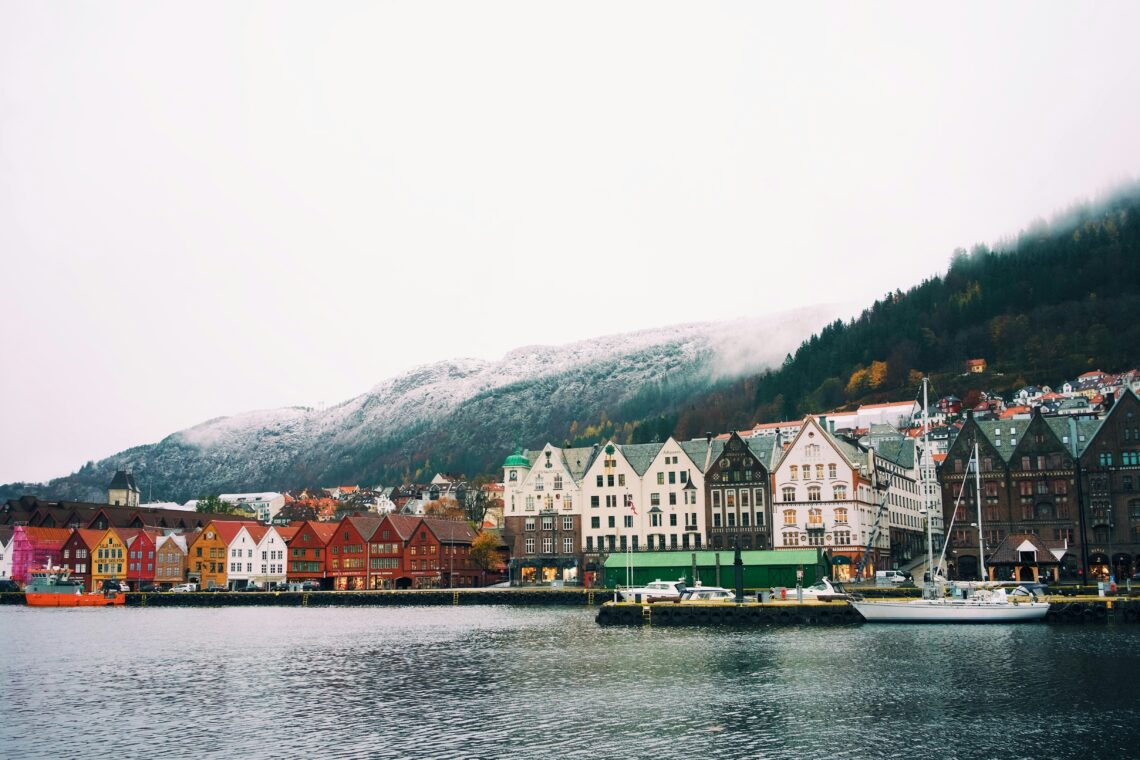
Beauty here emerges unintentionally. A row of buildings against grey water. Light catching briefly on wet stone. Nothing feels staged.
This practicality gives the coast its authenticity. What remains does so because it works.
Weather as a Creative Force
On the west coast, weather is not background. It edits the landscape constantly. Clouds lower ceilings. Rain deepens colour. Wind alters sound.
These changes don’t diminish the experience — they define it. The same place can feel entirely different within hours, not because it has changed, but because conditions have.
This instability encourages presence. You pay attention because you must.
High Ground, Open Exposure
Above the fjords, the land opens abruptly. Plateaus replace valleys. Shelter disappears. Wind becomes dominant.
This exposure sharpens awareness. Standing still feels active. Small movements feel intentional. The landscape offers no distraction, only clarity.
Here, the coast’s beauty feels stripped back — reduced to form, light, and movement.
Why the West Coast Lingers
Norway’s west coast stays with people not because it impresses immediately, but because it recalibrates expectation. Beauty unfolds slowly. Meaning forms through duration rather than moment.
Northern peaks and Atlantic shores do not compete for attention. They coexist, shaping a region where nature sets terms and human presence responds carefully.
To travel here is not to collect views, but to adjust pace — to learn how landscape, weather, and movement work together without urgency.
And in that adjustment, the west coast reveals its quiet strength: a beauty built not on spectacle, but on structure, persistence, and the confidence to remain unchanged by admiration.
Read more lifestyle and travel articles at ClichéMag.com
Images provided by Deposit Photos, BingAI, Adobe Stock, Unsplash, Pexels, Pixabay Freepik, & Creative Commons. Other images might be provided with permission by their respective copyright holders.